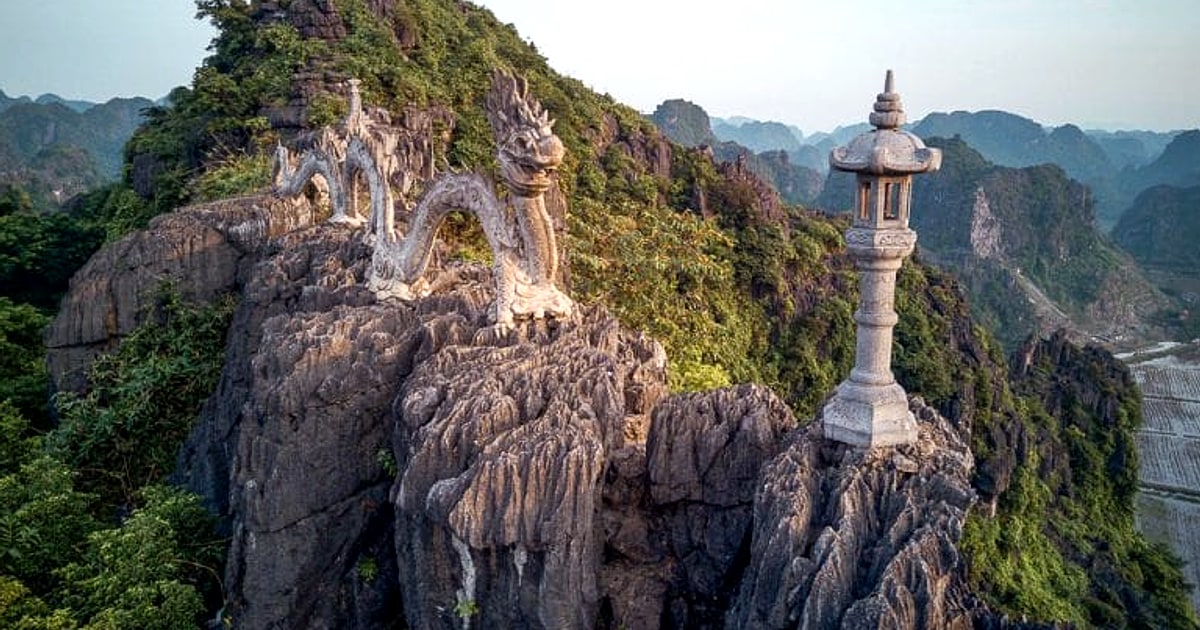
Between the tourist density of Tam Coc pier and the pagoda steps of Bích Đông, a quieter structure sits behind lotus ponds and ancient banyan trees, receiving a fraction of the foot traffic it deserves. Thai Vi Temple — built in the 13th century to honour the Trần dynasty kings who retreated to this valley after abdicating the throne — is precisely the kind of site that rewards the visitor who walks past the obvious attractions and keeps going.
This guide covers the history, architecture, and practical visiting information for Thai Vi Temple, including its connection to the Trần dynasty retreat and why this site offers one of the most contemplative experiences in Ninh Bình province.
At a glance:
- Thai Vi Temple — 13th-century Trần dynasty temple between Tam Coc and Bích Đông
- Free admission (no ticket required) — open daily 06:00–18:00
- Walking distance: 1.2 km from Tam Coc pier, 800m from Bích Đông pagoda
- Time needed: 30–45 minutes for a proper visit
- Best time: Early morning (06:00–08:00) or late afternoon (16:00–17:30) for lotus pond light
Historical Context: The Trần Dynasty Retreat
Thai Vi Temple dates to approximately 1258, when it was established to venerate Trần Thái Tông — the first king of the Trần dynasty, who abdicated in favour of his son and retired to this limestone valley to pursue Buddhist contemplation. The choice of location was not arbitrary: the karst formations provided natural isolation, the river offered transport access to the capital at Thăng Long (modern Hanoi), and the surrounding rice paddies ensured self-sufficiency for the monastic community that developed around the temple.
The temple subsequently expanded to honour three Trần kings: Trần Thái Tông (r. 1225–1258), Trần Thánh Tông (r. 1258–1278), and Trần Nhân Tông (r. 1278–1293) — the latter being particularly significant as both a military leader who defeated the Mongol invasions and a Buddhist monk who founded the Trúc Lâm Zen school. This combination of martial achievement and spiritual retreat gives Thai Vi Temple a complexity that most Ninh Bình temples lack.
Architecture and Layout
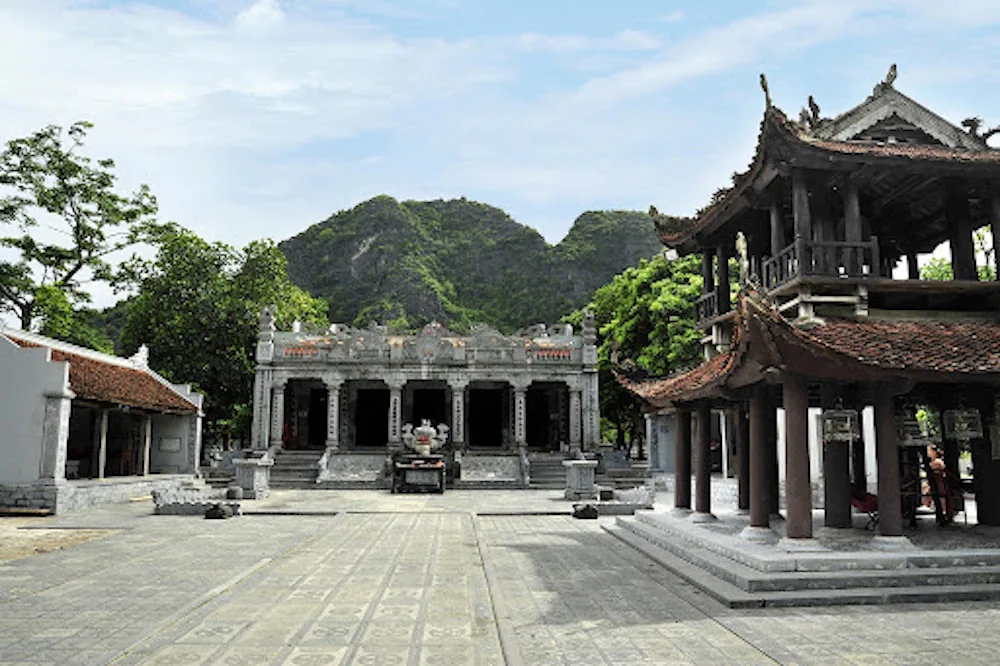
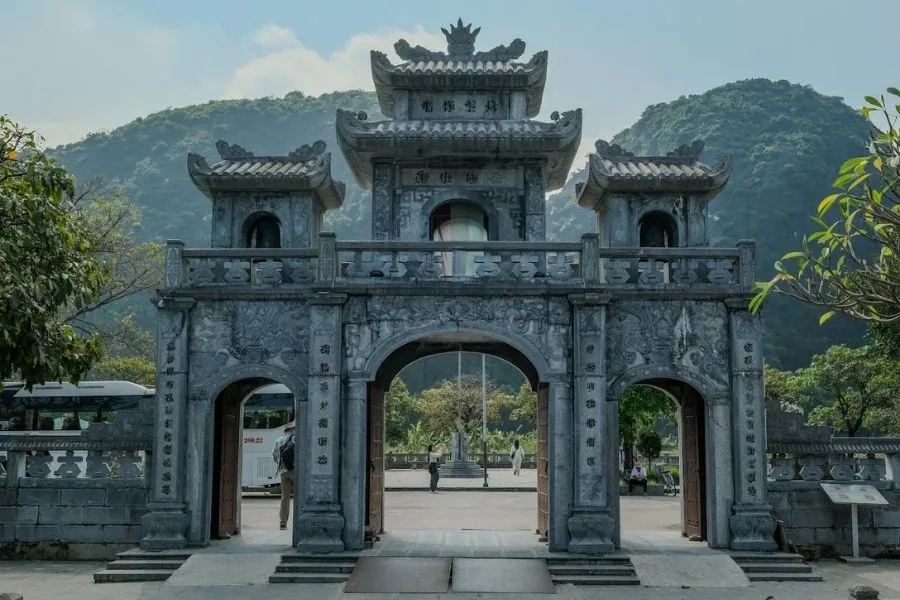
Thai Vi Temple follows the traditional Vietnamese đình layout — a horizontal succession of worship halls set behind a ceremonial courtyard. The current structures are predominantly 17th-century reconstructions, though the stone foundations and several carved pillars date to the original 13th-century construction. The stonework is notably finer than comparable sites in the region, featuring dragon motifs and lotus carvings that reflect the Trần dynasty’s artistic sophistication.
The temple compound includes three main halls. The front hall (tiền đường) contains ceremonial drums and bells. The middle hall (trung đường) houses the primary altars. The rear hall (hậu cung) contains the most significant artifacts — stone statues of the three Trần kings, carved with a naturalism that distinguishes them from the more stylised Buddhist iconography found at Bái Đính.
The surrounding grounds are, to my mind, the temple’s greatest asset. Two lotus ponds — one on each side of the approach path — bloom from May through September, creating a visual setting that I would describe as rather more impressive than one might expect from a site this modest in scale. Ancient banyan trees, estimated at 300–400 years old, provide shade and a sense of temporal depth that newer religious sites cannot replicate.
Visiting Thai Vi Temple: Practical Information
| Detail | Information |
|---|---|
| Location | Between Tam Coc pier and Bích Đông, Ninh Hải commune |
| Admission | Free (no ticket required) |
| Opening hours | 06:00–18:00 daily |
| Time needed | 30–45 minutes |
| Best combined with | Tam Coc boat ride + Bích Đông pagoda |
| Dress code | Cover shoulders and knees (active worship site) |
| Accessibility | Flat ground, wheelchair accessible to main courtyard |
How to Reach Thai Vi Temple
Thai Vi Temple sits on the path between Tam Coc pier and Bích Đông pagoda — a route most visitors cover by bicycle. From Tam Coc accommodation, the temple is a 5–10 minute bicycle ride through rice paddies. The approach road is paved and flat, passing through landscape that is itself worth the journey. From Hanoi, the temple is approximately 100 km south — a 2-hour drive or 2.5-hour train to Ninh Bình station followed by a 15-minute taxi to Tam Coc.
Why Thai Vi Temple Deserves Your Time
Most Ninh Bình visitors allocate their limited hours to the headline attractions — Trang An, Tam Coc, Mua Cave. Thai Vi Temple rarely appears on compressed itineraries, which is understandable but regrettable. The temple offers something the major sites cannot: silence, historical depth, and the particular atmosphere that develops in a place of active worship over eight centuries.

If your itinerary includes a bicycle ride between Tam Coc and Bích Đông — and it should — stopping at Thai Vi Temple adds 30 minutes and subtracts nothing. For photographers, the lotus ponds at dawn are among the finest compositions available in the province, requiring no entrance fee and no crowds.
The temple’s understated presence is, I suspect, precisely what protects it. In a province where tourism infrastructure expands annually, Thai Vi Temple remains a place where the past is not performed but simply present — in the worn stone steps, the incense smoke, and the banyan roots that have been growing longer than most nations have existed.
This article contains affiliate links. When you book through our partner links, we may earn a small commission at no additional cost to you. This supports our continued research across Ninh Bình province.
📌 Book this experience:
Check Ninh Binh tours on Klook | Browse on Klook
Some links are affiliate links. We earn a small commission at no extra cost to you.
Related: Bich Dong Pagoda | Tam Coc | Cycling Guide
For further reading: Lonely Planet’s Ninh Binh overview.
To arrange your visit with reliable transport, I recommend that you find Thai Vi Temple guided tours on 12Go for verified schedules and e-ticket booking.
Frequently Asked Questions
What is the historical significance of Thai Vi Temple?
Thai Vi Temple was constructed in the 13th century to honor the Tran Dynasty kings who ruled Vietnam from 1225 to 1400, including Tran Thai Tong — the dynasty’s founder who later abdicated to become a Buddhist monk in these very karst mountains. The temple occupies a narrow valley 2 kilometers from Tam Coc wharf, nestled between limestone cliffs chosen for their natural fortification properties.
How do I reach Thai Vi Temple from Tam Coc?
The most rewarding approach follows the 2-kilometer footpath or cycling lane from Tam Coc wharf through rice paddies and karst scenery, taking approximately 20-30 minutes on foot or 10 minutes by bicycle. Motorbikes can reach the temple via a paved road, but the walking route reveals the landscape context that explains why the Tran Dynasty chose this secluded setting. Entry is free, though small donations are customary.
Is Thai Vi Temple worth visiting alongside Tam Coc?
Thai Vi Temple offers the most accessible example of Tran Dynasty architecture in the Ninh Binh region, with original stone carvings and a serene courtyard that receives a fraction of Tam Coc’s visitor traffic. Combining a morning boat tour with an afternoon walk to Thai Vi creates a balanced itinerary that pairs natural spectacle with dynastic heritage — the very combination that earned the Trang An complex its UNESCO mixed-site designation.