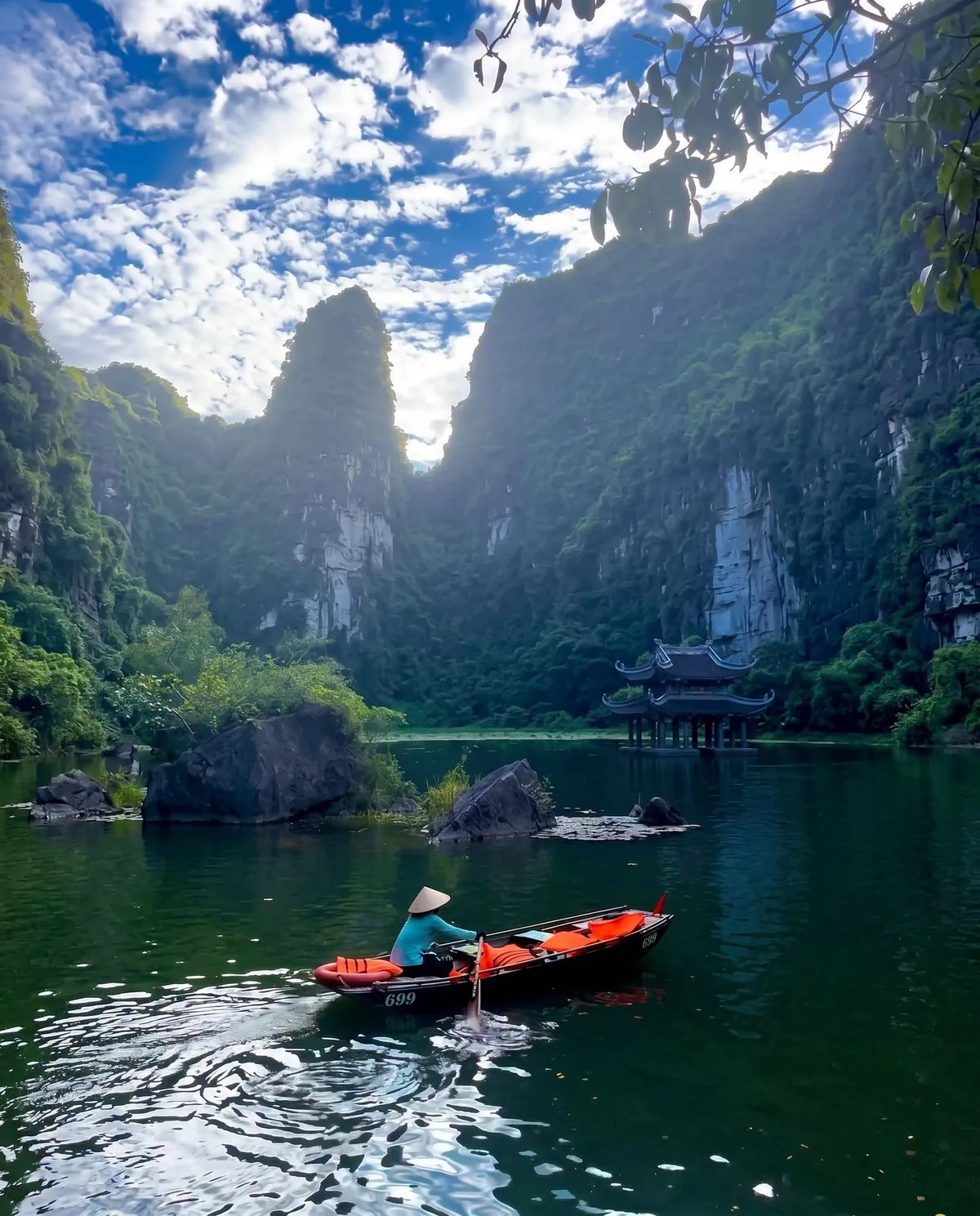
Trang An Ninh Binh is a UNESCO World Heritage boat tour through a limestone karst complex near Ninh Binh city, covering roughly 3 km over 2–2.5 hours through up to 9 caves. Tickets cost 250,000 VND ($10) per person as of Q2/2026; boats run 7:00 AM–4:00 PM daily, departing 7 km west of Ninh Binh city.
Trang An Ninh Binh is one of only 38 mixed UNESCO World Heritage Sites on the planet — recognised in 2014 for both its natural karst landscape and its cultural heritage spanning roughly 30,000 years of continuous human habitation. I have navigated all three boat routes through this limestone complex more times than my notebook can comfortably record, and I can say with some confidence that the Heritage Route remains the single most rewarding half-day experience in northern Vietnam. The boat tour costs 250,000 VND ($10) as of Q2/2026, covers approximately 3 kilometres over 2–2.5 hours, and passes through 9 cave passages on the Heritage Route — figures that represent, by any measure, extraordinary value for a World Heritage excursion.
At a Glance
| Detail | Information |
|---|---|
| Location | Trang An Scenic Landscape Complex, 7 km west of Ninh Binh city |
| UNESCO Status | Mixed World Heritage Site (2014) — criteria (v), (vii), (viii) |
| Ticket Price | 250,000 VND ($10) per person, Q2/2026 |
| Boat Capacity | 4–5 passengers per sampan |
| Operating Hours | 7:00 AM – 4:00 PM daily (last boat ~4:00 PM, returns ~6:30 PM) |
| Duration | 2–2.5 hours (Heritage Route) |
| Caves | 9 caves on Heritage Route; 5–6 on Routes 2 and 3 |
| Distance from Hanoi | 93 km south (2 hours by car/bus) |
| Annual Visitors | 3.8 million (2025) |
The UNESCO Inscription — Why Trang An Matters
The World Heritage Committee’s 2014 decision to inscribe the Trang An Landscape Complex was noteworthy for a reason that most guidebooks gloss over entirely. Trang An met three UNESCO criteria simultaneously: criterion (v) for its outstanding example of traditional human interaction with the landscape, criterion (vii) for superlative natural phenomena, and criterion (viii) for its geological record of karst evolution. The complex encompasses 6,172 hectares of core zone and 6,079 hectares of buffer — a total area roughly the size of San Marino.
For comprehensive planning, including transport, timing, and budget, see the complete guide to Ninh Binh.
Archaeological evidence from Nguoi Xua Cave and Mong Thanh Cave places continuous human habitation in this karst massif at approximately 30,000 years, making it one of the oldest documented sites of human settlement in Southeast Asia. The geological formation itself dates to the Permian period, approximately 250 million years ago — a timeframe that predates the dinosaurs by a comfortable margin.
The dual UNESCO recognition is genuinely rare. Of over 1,199 World Heritage Sites worldwide, only 38 hold mixed status. Trang An shares this distinction with places like Machu Picchu, Mount Athos, and Goreme — company that, I confess, still surprises visitors who arrive expecting “just a boat ride.”
Three Trang An Boat Routes Compared — Which to Choose
Trang An operates three distinct boat routes, each following a different path through the karst complex. I have completed all three, and the differences matter considerably more than the ticket booth signage suggests.
| Factor | Route 1 (Heritage) | Route 2 | Route 3 |
|---|---|---|---|
| Duration | 2–2.5 hours | ~2 hours | ~2 hours |
| Caves | 9 caves | 6 caves | 5 caves |
| Temples | 2 temples | 3 temples | 2 temples |
| Highlights | Most scenic, UNESCO core zone, longest caves | Temple-focused, quieter | Newest route, least crowded |
| Best For | First-time visitors, photographers | Heritage enthusiasts, repeat visitors | Those avoiding crowds |
| Crowd Level | Moderate–high (most popular) | Moderate | Low |
Route 1: The Heritage Route (Recommended)
The Heritage Route passes through 9 cave passages — including Hang Toi (Dark Cave) at roughly 320 metres, the longest navigable cave in the complex. The boat glides through caverns where stalactites have been forming since the Late Pleistocene, emerging into enclosed limestone valleys that the Vietnamese call “trang” — a word with no precise English equivalent, though “hidden valley” comes close. Two temple stops punctuate the journey: Trinh Temple, dedicated to the guardian spirit of the landscape, and another shrine carved into the cliff face.
This is the route featured in Kong: Skull Island (2017), which used several of these karst valleys as filming locations. The production team reportedly chose Trang An over 50 other locations across Vietnam — a decision I find cinematographically sound, if somewhat disruptive to the langur population at the time.
Film enthusiasts may recognise several caves along the Heritage Route from Kong: Skull Island filming locations within the complex.
Route 2: The Temple Route
Route 2 emphasises the cultural dimension, visiting three temples over approximately 2 hours through 6 caves. The caves are shorter than those on Route 1, but the temple architecture — particularly the cliff-side shrines dating to the Tran Dynasty (1225–1400) — rewards closer inspection. I find this route more contemplative, though I concede that “contemplative” is not everyone’s priority on holiday.
Route 3: The Quiet Route
The newest addition, Route 3 passes through 5 caves and 2 temples. It draws roughly 30% fewer visitors than Route 1, making it the logical choice during peak weekends (July–August) or Vietnamese public holidays. The karst scenery is comparable, if slightly less dramatic in scale.
Trang An Boat Tour — Practical Information (2026)
The boat tour operates on a simple, well-organised system. All three routes depart from the same ticket hall at the Trang An Scenic Area entrance.
| Detail | Information |
|---|---|
| Ticket Price | 250,000 VND ($10) per person — all routes, same price |
| Boat Type | Traditional metal sampan, rowed by foot |
| Passengers per Boat | 4–5 maximum (weight-dependent) |
| Departure Times | Continuous from 7:00 AM to 4:00 PM |
| Last Return | Approximately 6:30 PM |
| What’s Included | Boat, rower, life jacket, temple entry |
| Tipping | Not mandatory, 50,000–100,000 VND appreciated |
| Facilities | Toilets, restaurants, parking at entrance complex |
The rowers — predominantly local women from surrounding villages — navigate the boat using a remarkable foot-rowing technique that allows them to steer and propel simultaneously. The community-based tourism programme employs approximately 2,400 local boatwomen, whose livelihoods depend directly on the river’s ecological health.
Best Time to Visit Trang An
Peak visiting hours at Trang An are 9:30 AM to 2:00 PM. I prefer the 7:00 AM opening slot, when morning mist sits in the limestone valleys and the only sounds are paddles against water and the occasional kingfisher. The 3:00 PM afternoon session offers golden light that photographers find particularly rewarding — Trang An sunset has earned its reputation.
The monsoon season runs from May through October, with July and August seeing the heaviest rainfall — often in short, intense bursts between 2:00 PM and 5:00 PM. The boats operate rain or shine, and the karst valleys in mist have an atmosphere that dry-season photographs cannot capture.
| Season | Months | Conditions | Recommendation |
|---|---|---|---|
| Dry Season | Nov–Apr | Clear skies, 18–28°C | Best overall |
| Golden Rice | Late May–Jun | Paddies turn gold, hot | Photogenic but humid |
| Monsoon | Jul–Sep | Afternoon rain, 30–34°C | Atmospheric, fewer crowds |
| Autumn | Oct–Nov | Mild, dry, clear | Ideal — my preferred season |
Kong: Skull Island — The Filming Connection
Trang An served as a primary filming location for Kong: Skull Island (2017), with several enclosed karst valleys doubling as the prehistoric landscape of Skull Island. The production chose Trang An over 50 other Vietnamese locations after an extensive scouting process. While I confess that my interest in the film is primarily geological rather than cinematic, the Kong connection has undeniably raised international awareness of the site — visitor numbers increased 34% in the year following the film’s release.
The filming locations are visible on Route 1, but there are no permanent markers or signs. If this matters to you, ask your rower to point them out — most know exactly which valleys were used. The production reportedly left zero permanent structures, which is the correct approach to heritage-zone filming.
Where to Stay Near Trang An
Trang An accommodation options range from 200,000 VND ($8) backpacker dorms to 4,500,000 VND ($180) heritage boutique suites. The Tam Coc area, approximately 7 km south, offers the densest concentration of guesthouses and homestays with rice field views.
For a smaller-scale experience, consider the Tam Coc boat ride, a more intimate alternative with rice field scenery.
For those prioritising proximity to Trang An’s entrance, the Trang An–Hoa Lu corridor along the DT477 road has several properties within 2–3 km of the boat dock. I generally recommend staying in the Tam Coc area for the broader range of dining and cycling options, then taking a 15-minute taxi or motorbike ride to Trang An.
Visitors with additional time frequently combine their Trang An boat tour with the Hoa Lu temples, 4 km from the pier, where the Dinh and Le Dynasty courts once held power.
Check room availability on Booking.com or compare nightly rates on Agoda for current Trang An accommodation deals. Properties with verified guest reviews tend to be the most reliable indicator of quality in this area.
Getting to Trang An
| Transport | From | Duration | Cost (Q2/2026) |
|---|---|---|---|
| Taxi/Grab | Ninh Binh city | 15 min | 60,000–80,000 VND ($2.50–$3.20) |
| Motorbike | Tam Coc area | 20 min | Self-drive, 120,000–150,000 VND/day rental |
| Bicycle | Tam Coc area | 35–45 min | 50,000–80,000 VND/day rental |
| Tour bus | Hanoi (day trip) | 2 hours | Included in tour package |
| Train + taxi | Hanoi station | 2h20 + 15 min | 75,000–150,000 VND + taxi |
The 6:00 AM express train from Hanoi (SE1) reaches Ninh Binh station at approximately 8:20 AM — sufficient time for the 7-km taxi to Trang An and a morning boat departure. For the complete transport breakdown, see my guide to getting from Hanoi to Ninh Binh.
I cover all transport options in my guide to getting to Trang An from Hanoi.
Trang An vs Tam Coc — A Brief Comparison
Both sites offer sampan boat tours through karst landscapes, but the experience differs substantially. Trang An emphasises caves and heritage (UNESCO-inscribed, 9 caves on the Heritage Route), while Tam Coc follows the Ngo Dong River through rice paddies with 3 caves. The distinction is geological versus agricultural — and both are worth your time if you have 2 or more days in Ninh Binh.
For my detailed side-by-side analysis, see the Tam Coc vs Trang An comparison. The short version: visit Trang An for caves and history, Tam Coc for rice fields and photography. Ideally, do both.
Combining Trang An with Other Sites
A well-planned day from Trang An can incorporate several nearby heritage sites:
- Hoa Lu Ancient Capital (5 km north) — Vietnam’s first imperial city, Dinh Dynasty 968 AD. Entry: 20,000 VND. Allow 1–2 hours.
- Mua Cave viewpoint (8 km south) — 486 steps to the finest panorama in the province. Entry: 100,000 VND. Allow 1.5 hours.
- Bai Dinh Pagoda (12 km northwest) — Vietnam’s largest pagoda complex, 539 hectares. Free entry. Allow 2–3 hours.
- Tam Coc boat tour (7 km south) — The rice paddy alternative. 150,000 VND per boat. Allow 2 hours.
I generally recommend booking a full-day Trang An + Hoa Lu + Mua Cave combination through GetYourGuide for the review transparency, or check the Klook listing for similar packages with instant confirmation.
Conservation and Responsible Visiting
The tension between heritage conservation and tourism revenue is, I confess, the central question I grapple with in nearly everything I write about Ninh Binh. Trang An received 3.8 million visitors in 2025. Visitor carrying capacity studies conducted by Hanoi University of Science (2022) recommend a maximum of 3,500 daily visitors to the boat tour — a threshold that is, by my observation, exceeded on most summer weekends.
The provincial government’s 2026 sustainability framework targets a 30% reduction in single-use plastics within heritage zones by 2028. The shift from diesel to electric boats on the neighbouring Tam Coc river, completed in 2024, reduced underwater noise by approximately 75% — a transition that Trang An’s management board is reportedly studying for future implementation.
What you can do: carry your rubbish out (there are no bins inside the caves), avoid touching stalactites, and resist the temptation to trail your fingers in the water when the boat enters cave passages — the silt disturbance affects the micro-ecosystem. These are small courtesies that, multiplied by 3.8 million visitors, become consequential.
Frequently Asked Questions
How much does the Trang An boat tour cost in 2026?
The Trang An boat tour costs 250,000 VND ($10) per person as of Q2/2026. This single ticket covers the boat, rower, life jacket, and temple entry fees. All three routes are the same price. Tipping the rower is not mandatory but appreciated — 50,000 to 100,000 VND is standard. The price has remained stable since 2024.
Which Trang An boat route is best?
Route 1 (Heritage Route) is the best choice for first-time visitors. It passes through 9 caves — the most of any route — over 2–2.5 hours and covers the UNESCO core zone. Route 2 suits heritage enthusiasts interested in temple architecture. Route 3 is ideal for avoiding crowds, drawing roughly 30% fewer visitors than Route 1.
How long does the Trang An boat tour take?
The Heritage Route (Route 1) takes 2–2.5 hours. Routes 2 and 3 take approximately 2 hours each. Factor in 15–20 minutes for ticketing and boarding. I recommend arriving by 7:00 AM for the quietest experience — by 9:30 AM, the queue at the ticket hall can stretch to 30 minutes.
Is Trang An or Tam Coc better?
Trang An and Tam Coc offer different experiences. Trang An has more caves (9 vs 3), UNESCO heritage status, and longer routes. Tam Coc follows the Ngo Dong River through rice paddies — more photogenic during harvest season (late May–June). Trang An costs 250,000 VND vs Tam Coc’s 150,000 VND per boat. For my full comparison, read the Tam Coc vs Trang An analysis on this site.
Can I visit Trang An on a day trip from Hanoi?
Yes, but it is tight. The drive takes approximately 2 hours each way, leaving 4–5 hours for the boat tour and any additional sites. Most day trips from Hanoi combine Trang An with Hoa Lu and Mua Cave. I recommend booking through GetYourGuide or Klook for organised day trips with hotel pickup from Hanoi’s Old Quarter. For a more thorough experience, I suggest staying 2–3 nights in the Tam Coc area — see my Ninh Binh travel guide for planning.
The road from Trang An also provides access to Bai Dinh Pagoda, accessible on the same road — a Buddhist complex of genuinely staggering proportions.
Prices are approximate as of Q2/2026 and subject to change. Verify current rates at the Trang An ticket office before visiting.