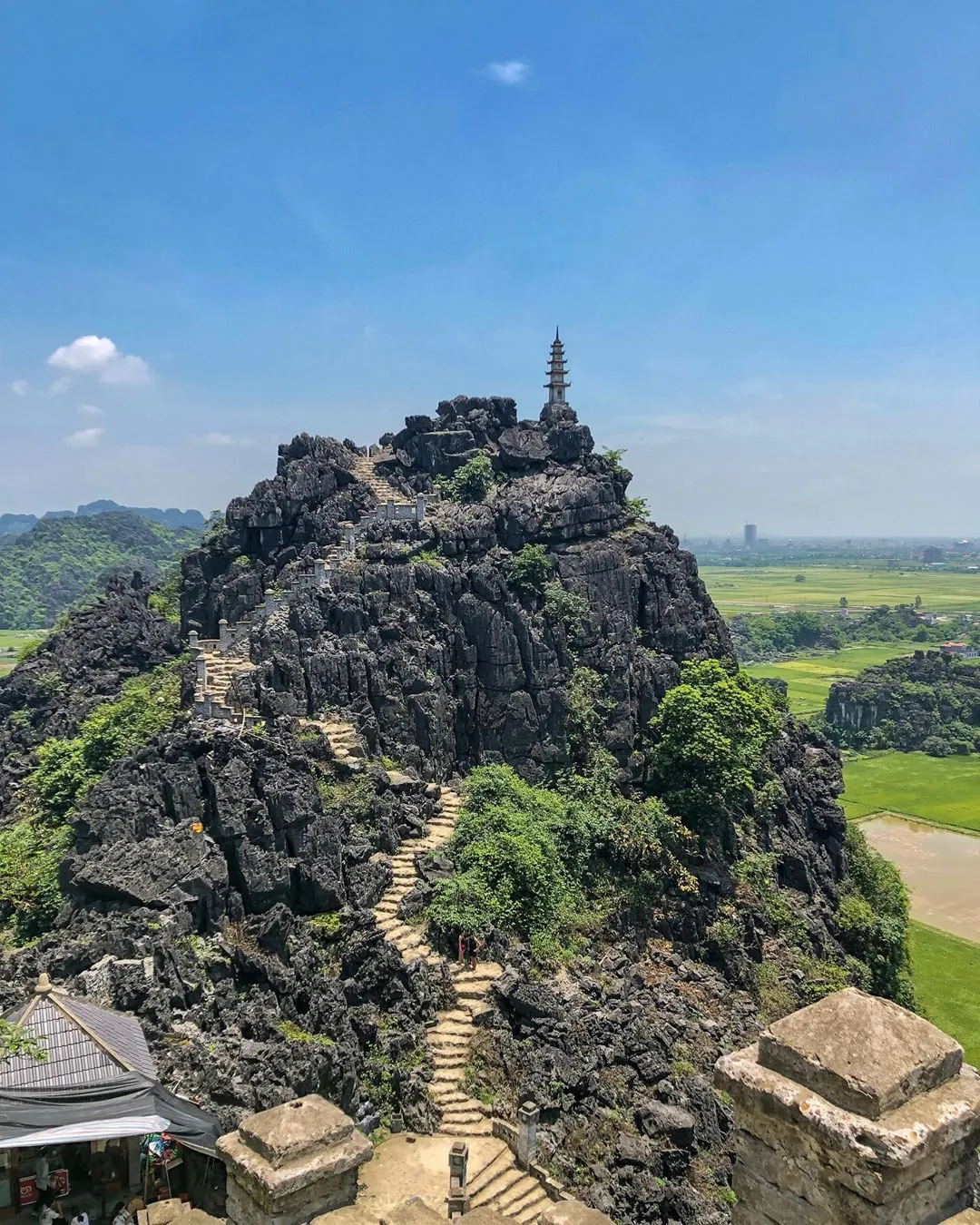
Mua Cave Ninh Binh — known locally as Hang Mua — requires precisely 486 stone steps to reach a limestone summit roughly 120 metres above the Tam Coc valley floor. The entrance fee is 100,000 VND ($4). The climb takes 20–25 minutes at a moderate pace, and the reward at the top is a 360-degree panorama that has graced more travel photography portfolios than I suspect the Tran Dynasty kings who once watched court dances here ever imagined possible. I have climbed these steps in every season since 2019, at dawn and dusk, in monsoon rain and January chill, and the view has not once failed to justify the exertion — or the mild complaint from my left knee.
From the summit, the panorama extends across the Tam Coc valley to the Tam Coc boat pier below.
At a Glance
| Detail | Information |
|---|---|
| Full Name | Hang Mua (Mua Cave / Dance Cave) |
| Location | Khe Ha Village, Ninh Xuan Commune, Hoa Lu District — 2 km from Tam Coc wharf, 7 km from Ninh Binh city centre |
| Mua Cave Height | ~120 m above the valley floor |
| Total Steps | 486 stone steps to the dragon summit |
| Climb Duration | 20–25 min at moderate pace |
| Entrance Fee | 100,000 VND ($4) per person, Q2/2026 |
| Opening Hours | 6:00 AM – 6:00 PM daily |
| Best Time to Visit | Sunrise (6:00–7:00 AM) or late afternoon (4:00–5:30 PM) |
| Coordinates | 20.2148° N, 105.8624° E |
| Difficulty | Moderate — manageable for most fitness levels |
History of Hang Mua — Where Kings Watched Court Dances
The name “Mua” translates to “dance” in Vietnamese, and the historical explanation is more specific than most guidebooks allow. During the Tran Dynasty (1225–1400), this limestone karst served as a performance venue where royalty gathered to observe court dances staged on the flat ground below the mountain. The Tran kings had relocated Vietnam’s capital to Hoa Lu — located just 3 km north of present-day Hang Mua — following the earlier Dinh Dynasty (968–980), making the surrounding karst landscape something of a royal backyard.
For comprehensive trip planning, read the full Ninh Binh guide.
Archaeological records from the Hoa Lu Ancient Capital complex confirm that the area’s limestone peaks functioned not merely as natural fortifications but as ceremonial gathering points. The cave at the base of the mountain, which gives Hang Mua its official designation, contains a modest shrine that predates the tourist infrastructure by several centuries.
The Tran Dynasty connection is worth pausing over. These were the same rulers who repelled three Mongol invasions between 1258 and 1288 — a military achievement that still ranks among the most remarkable defensive campaigns in Asian history. That they found time between repelling Kublai Khan’s armies to watch dances at the foot of a limestone peak says something rather endearing about medieval Vietnamese priorities. For more on this period, see my notes in the Hoa Lu Ancient Capital guide.
The Mua Cave Climb — 486 Steps, Step by Step
The 486 mua cave steps begin at the garden complex behind the ticket booth and ascend the eastern face of the karst peak. The path splits roughly two-thirds up: the left fork leads to a lower observation platform with a Quan Am (Guanyin) statue, while the right fork continues to the summit where a dragon sculpture coils along the ridge. Take the right fork. The dragon viewpoint is the destination that earns this spot its reputation.
Difficulty and Fitness Requirements
I want to be precise about the physical demands, because online descriptions range from “easy stroll” to “gruelling mountain hike” — both of which miss the mark entirely. The steps are stone-cut, uneven in places, and vary between 15 and 25 cm in height. Steel handrails line approximately 80% of the route, though the final 50-metre stretch near the summit narrows considerably.
Those who enjoyed the climb will find more options in my guide to other hiking trails near Ninh Binh.
A reasonably fit adult will complete the mua cave hike in 20–25 minutes. Visitors over 60 or those with knee conditions should budget 30–40 minutes and bring a walking stick. Children aged 6 and above manage the climb routinely — I have watched Vietnamese families with toddlers in carriers make the ascent, though I would not personally recommend it with anyone under 4.
What to Bring
| Item | Why |
|---|---|
| Water (500 ml minimum) | No vendors above the halfway point |
| Trainers or hiking sandals | Steps are slippery when wet — flip-flops are inadvisable |
| Sunscreen + hat | No shade cover on the upper third |
| Light towel | Humidity averages 80%+ from May to October |
| Camera with wide-angle lens | The 360° panorama demands it |
The Mua Cave Viewpoint — What You See From the Top
The summit rewards those 486 steps with a panorama that I would characterise, in academic terms, as the single finest vantage point in the Trang An–Tam Coc karst landscape. The hang mua viewpoint provides unobstructed sightlines in every direction.
Looking south: The Ngo Dong River carves its slow, green course through rice paddies toward the three caves that give Tam Coc its name. In the June–September rice season, the paddies turn an almost unbelievable shade of emerald. By late September, the golden harvest palette takes over — both phases are worth photographing.
Looking north and east: Dozens of karst towers — geologists call them tower karst or fenglin — punctuate the flat alluvial plain. On clear mornings, you can count upwards of 30 individual peaks from the dragon’s spine. The geological formation dates to the late Permian era, approximately 250 million years ago.
Looking west: The Tam Coc valley opens into the broader Trang An complex. On days without haze — roughly November through February — the UNESCO-inscribed landscape extends to the horizon, a continuous procession of limestone and water.
The viewing platform at the summit accommodates perhaps 15–20 people at once. At peak hours (9:00–11:00 AM), the wait to photograph beside the dragon can stretch to 10–15 minutes. Arriving before 7:00 AM eliminates this entirely.
Best Time to Visit Mua Cave Ninh Binh — Sunrise vs. Sunset
Timing your visit correctly makes a measurable difference to both the photographic quality and your comfort on those 486 steps. I have tested every window systematically over seven years. Here is what the data shows.
Sunrise at Mua Cave (6:00–7:00 AM)
The gates open at 6:00 AM, and this is the slot I recommend without reservation. In dry season (October–March), first light hits the Tam Coc valley between 5:50 and 6:20 AM, casting long golden shadows across the rice fields and river. The temperature sits around 18–22°C from November to February, making the climb comfortable rather than punishing.
You will share the summit with perhaps 5–10 other early risers rather than the 40–60 present by mid-morning. For detailed sunrise photography planning, my Mua Cave sunrise guide covers exact angles and seasonal light patterns.
Photographers aiming for the golden hour should consult my sunrise photography guide for Mua Cave.
Late Afternoon (4:00–5:30 PM)
The second-best window. The sun drops behind the western karst peaks between 5:15 PM (December) and 6:30 PM (June), producing backlit silhouettes of the tower karst that photograph exceptionally well. The downside: you are descending 486 steps in diminishing light. Bring a phone torch.
Seasons and Weather
| Season | Months | Temperature | Conditions | Verdict |
|---|---|---|---|---|
| Dry/Cool | Oct – Feb | 15–22°C | Clear skies, low humidity, golden light | Best overall |
| Dry/Warm | Mar – Apr | 22–28°C | Haze possible, rice planting begins | Good mornings |
| Wet/Green | May – Sep | 28–35°C | Afternoon rain, vivid green paddies | Sunrise only |
For a detailed month-by-month breakdown, the Ninh Binh weather guide provides precipitation data and temperature charts.
The karst landscape surrounding Mua Cave falls within the buffer zone of the Trang An UNESCO World Heritage Site. Provincial authorities imposed construction restrictions in 2016 to prevent commercial overdevelopment along the Tam Coc corridor. When visiting, stay on marked paths and resist the temptation to carve initials into the limestone — these formations required roughly 250 million years to develop. Undoing graffiti damage is, regrettably, beyond even UNESCO’s considerable budget.
Photography Tips and Drone Regulations
Mua Cave ranks among northern Vietnam’s most photographed locations — and for sound reasons. The combination of foreground (dragon sculpture), midground (river and paddies), and background (karst towers) creates natural compositional depth that works on everything from smartphones to medium-format cameras. For a comprehensive location guide, see the Ninh Binh photography spots article.
Camera Settings and Composition
Sunrise: Shoot toward the southeast. Use a focal length of 16–24 mm to capture the river, paddies, and karst towers in a single frame. Bracketed exposures help manage the dynamic range between shadowed valleys and bright sky. A polarising filter cuts haze and enriches the greens of the rice fields — particularly effective between June and September.
Dragon sculpture portraits: The dragon’s head faces northeast. Position yourself on the lower step immediately behind the sculpture for the classic composition — the dragon in the foreground with the Tam Coc valley below. Arrive before 7:00 AM or after 4:30 PM to avoid queuing.
Drone Rules
Vietnam’s drone regulations were updated in 2025 under Decree 36/2008/NĐ-CP amendments. Flying drones within the Trang An UNESCO buffer zone requires a permit from the Ninh Binh Provincial People’s Committee — a process that takes 5–7 business days and costs approximately 500,000 VND ($20). Flying without a permit risks confiscation and fines of 10–20 million VND ($400–$800). I have watched three tourists lose their equipment to local authorities in the past two years alone. The permit is worth obtaining if aerial footage is genuinely important to you.
How to Get to Mua Cave
Mua Cave sits 7 km south of Ninh Binh city centre and approximately 2 km from the Tam Coc boat wharf. Every transport option from Ninh Binh reaches Hang Mua in under 15 minutes.
From Ninh Binh City
| Transport | Duration | Cost (Q2/2026) | Notes |
|---|---|---|---|
| Bicycle | 25–30 min | 50,000–80,000 VND/day ($2–3) rental | Flat terrain, scenic route via rice paddies |
| Motorbike | 10–12 min | 120,000–150,000 VND/day ($5–6) rental | Most flexible option |
| Grab/taxi | 8–10 min | 40,000–60,000 VND one way | Available but supply limited |
| Guided tour | Included | Varies by operator | Typically combined with Tam Coc |
From Hanoi
Hanoi sits 93 km north of Ninh Binh. The journey takes approximately 2 hours by road. Full transport options — including the SE1 train departing Hanoi at 6:00 AM (75,000–150,000 VND, 2 hours 20 minutes) and limousine vans with hotel pickup (250,000–350,000 VND) — are detailed in the Hanoi to Ninh Binh transport guide.
Klook offers a Mua Cave plus Tam Coc combo tour that includes Hanoi pickup — convenient if you prefer not to arrange transport independently.
Combine Mua Cave With Tam Coc — A Natural Pairing
Mua Cave and Tam Coc sit just 2 km apart, making a combined visit the most efficient half-day itinerary in the area. The Tam Coc boat ride along the Ngo Dong River costs 150,000 VND ($6) per boat (maximum 2 passengers), lasts 90–120 minutes, and passes through three natural cave passages.
Recommended Sequence
Option A — Sunrise priority: Arrive at Mua Cave by 6:00 AM. Climb, photograph, descend by 7:30 AM. Drive or cycle 2 km to the Tam Coc wharf. Board a boat by 8:00 AM — before the tour-bus crowds arrive after 9:30 AM.
Option B — Afternoon light: Take the Tam Coc boat from 1:00–3:00 PM, then drive to Mua Cave for the late afternoon light from 4:00–5:30 PM. This sequence works particularly well from March to May, when afternoon haze has not yet built to summer intensity.
For broader itinerary planning, the Ninh Binh travel guide covers multi-day options that incorporate Mua Cave alongside Trang An, Bai Dinh Pagoda, and Cuc Phuong National Park.
What to Expect at the Base — Gardens, Cafe, and Facilities
The Mua Cave complex at ground level has expanded considerably since my first visit in 2019. The landscaped gardens include a lotus pond (photogenic from June to August), several small shrines, and a man-made waterfall. A cafe near the entrance sells drinks and light snacks — the iced Vietnamese coffee here costs 25,000 VND and is entirely adequate fuel for the descent.
Toilets are available near the ticket office and beside the cafe. There are no restroom facilities on the climb itself or at the summit. Lockers are not provided, so carry your valuables with you — the climb is not technical enough to require stashing bags.
The base area also features a small exhibition on local geology and Hoa Lu–era history. It receives far fewer visitors than the summit, which is a mild injustice given the quality of the geological cross-section diagrams on display. Budget 15–20 minutes if earth science holds any interest for you.
Mua Cave for Hikers — Connecting Trails
While the 486 steps to the mua cave viewpoint constitute the primary draw, the surrounding Hoa Lu District offers additional hiking trails for those who want more than a single climb. The ridge walk that continues beyond the dragon summit — unmarked and unofficial but well-trodden — extends roughly 800 metres along the karst spine before the path becomes impassable. The views from this extension are less obstructed than from the main platform, though the footing is rougher and handrails are absent.
Cyclists who want to extend the day can ride the 12 km loop through the rice paddies between Tam Coc and Trang An, passing through farming villages that see relatively few international visitors. The terrain is flat, the road surfaces are acceptable, and the scenery is — well, it is the same karst landscape that earned the UNESCO inscription, viewed from a bicycle seat rather than a boat.
Frequently Asked Questions
Is the Mua Cave climb hard?
The climb is moderate. The 486 stone steps are uneven in places, and the upper section narrows, but steel handrails cover approximately 80% of the route. A reasonably fit adult completes it in 20–25 minutes. Visitors with knee conditions should bring a walking stick and budget 30–40 minutes.
How many steps are there at Mua Cave?
There are exactly 486 stone steps from the base to the dragon summit. Some sources incorrectly cite 500 steps — the actual count is 486, which I have personally verified on multiple occasions (one counts these things when one is a historian with time to spare).
What is the best time to visit — sunrise or sunset?
Sunrise. The gates open at 6:00 AM, the light from the east illuminates the Tam Coc valley beautifully, temperatures are cooler, and crowds are minimal. Late afternoon (4:00–5:30 PM) is the second-best option, offering backlit karst silhouettes, though descending in low light requires caution.
How much is the Mua Cave entrance fee?
The entrance fee is 100,000 VND ($4) per person as of Q2/2026. Children under 1 metre tall enter free. There is no additional charge for cameras or tripods.
Can children climb Mua Cave?
Children aged 6 and above handle the climb routinely with parental supervision. The handrails are accessible for most children above 1 metre tall. For children under 4, the steps are too irregular and the summit area too exposed for comfort — I would advise against it.
Dr. James Whitford is a British historian specialising in Southeast Asian heritage. He holds a PhD from Cambridge and has lived in Hanoi since 2018. His Ninh Binh field notes are updated quarterly based on on-site visits.
Disclaimer: bestofninhbinh.com is an independent travel guide. Prices, hours, and policies are verified as of Q2/2026 but may change without notice. Always confirm details locally before visiting.
For a quieter ascent, consider the cave temple at Bich Dong, 3 km west, offering atmosphere without the crowds.