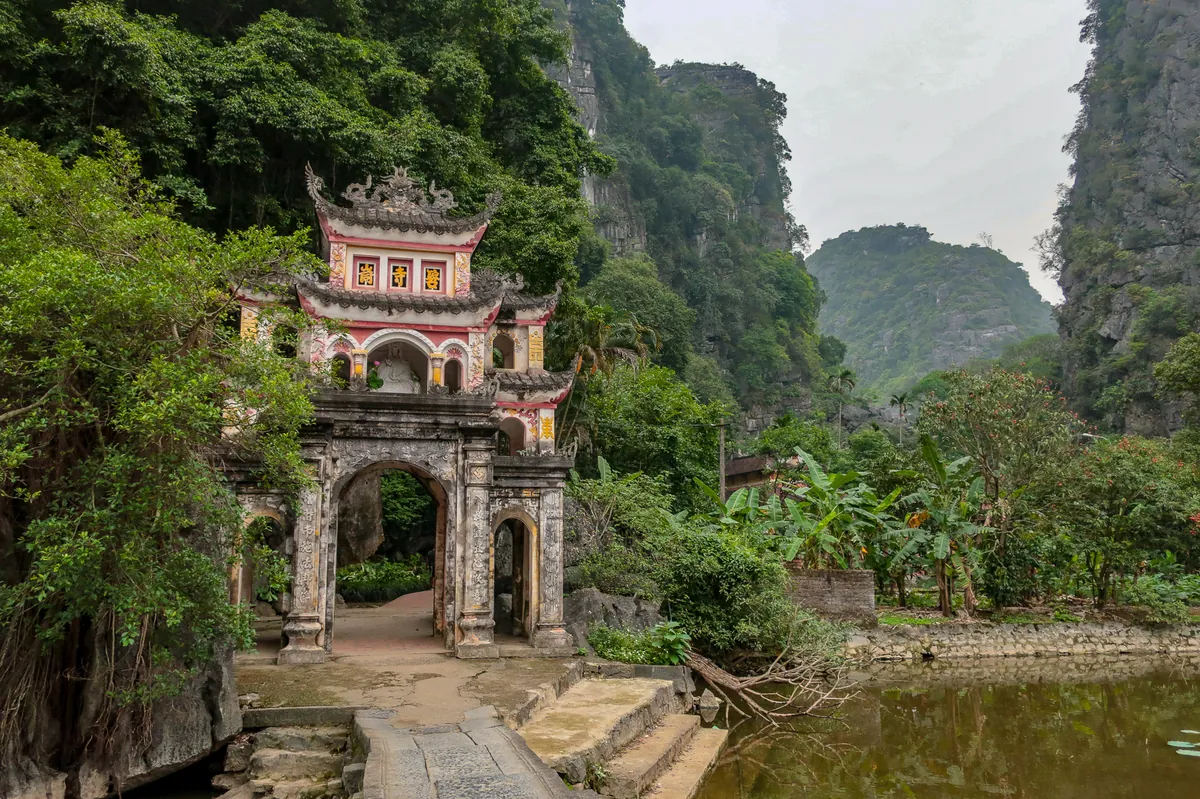
Bich Dong Pagoda Ninh Binh has carried the epithet “the second most beautiful grotto in the land” since the poet Nguyen Nghiem bestowed it in 1773 — an inscription that still survives, carved into the cliff face at the cave entrance. The pagoda complex comprises three levels built directly into and onto a limestone cliff: the Lower Pagoda (Chua Ha), the Middle Pagoda (Chua Trung) carved into the cave itself, and the Upper Pagoda (Chua Thuong) perched at the summit with views across the Tam Coc valley. Entry is free. The walk to the top takes 15–20 minutes. And yet this site receives a fraction of the visitors who queue at nearby Tam Coc — a discrepancy I find both regrettable and, selfishly, rather convenient.
At a Glance
| Detail | Information |
|---|---|
| Location | 2 km south of Tam Coc Boat Station, Ninh Hai commune |
| Founded | 1428 (Le Dynasty) |
| Current Structures | Reconstructed 18th century; inscription dated 1773 |
| Entry Fee | Free |
| Duration | 45 minutes – 1.5 hours |
| Levels | 3: Lower (Chua Ha), Middle (Chua Trung), Upper (Chua Thuong) |
| Heritage Status | Designated National Heritage Site |
| Famous Inscription | “Nam thien de nhi dong” (Second finest grotto under southern sky) |
| Best Time | Early morning (7:00–9:00 AM) for light and solitude |
| Dress Code | Modest — cover shoulders and knees |
History — From Le Dynasty to Nguyen Nghiem’s Inscription
Bich Dong Pagoda traces its founding to 1428, during the early Le Dynasty — the same period that saw Le Loi drive the Ming Chinese from Vietnamese territory and establish one of the country’s most consequential ruling houses. The original structures were modest: a stone altar within the cave, a meditation platform at the cliff base, and carved steps connecting them.
The pagoda’s fame, however, derives from a later period. In 1773, the mandarin-poet Nguyen Nghiem — father of the celebrated poet Nguyen Du, who would later write the Truyen Kieu — visited the grotto and inscribed four characters on the cliff face: “nam thien de nhi dong.” The phrase translates as “the second finest grotto under the southern sky,” a ranking that places Bich Dong behind only Huong Tich Cave (Perfume Pagoda) near Hanoi in the hierarchy of Vietnamese sacred grottoes.
The inscription survives, though weathering has softened the characters to the point where a casual visitor might walk past them. I have spent an embarrassing amount of time photographing these four characters from various angles, none of which adequately capture the quality of the calligraphy. Occupational hazard.
The Le Dynasty (1428–1789) is significant for more than military achievement. Under Le patronage, Buddhism experienced a revival that produced many of the cave temples we see today across northern Vietnam. Bich Dong represents this tradition at its most refined — architecture that works with the geological form rather than against it. The monks who chose this site understood something that modern architects are still learning: the cave was the building; their task was merely to furnish it.
The Three Levels of Bich Dong Pagoda
Level 1: The Lower Pagoda (Chua Ha)
The approach to Bich Dong begins at a stone gate flanked by two ancient banyan trees, beyond which a courtyard opens onto a lotus pond. The Lower Pagoda sits at ground level — a traditional Vietnamese Buddhist prayer hall with tiled roof and wooden pillars, housing several Buddha statues and an altar for incense offerings. This is the most accessible level, suitable for visitors of all mobility levels.
The courtyard is particularly atmospheric at dawn, when incense smoke from early morning prayers drifts across the still water of the lotus pond and the only sounds are the bell from inside the prayer hall and birdsong from the karst cliff above.
Level 2: The Middle Pagoda (Chua Trung) — The Cave Temple
The Middle Pagoda is the architectural centrepiece: a Buddhist shrine built directly into a natural limestone cave, approximately 30 metres above the courtyard. Stone steps — worn smooth by centuries of monks and pilgrims — lead up the cliff face to the cave entrance, where stalactites frame a dark interior illuminated by candles and natural light filtering through fissures in the rock.
Inside, the cave measures roughly 25 metres deep and 15 metres wide. Buddhist statues sit on stone altars between stalactite columns. The rock ceiling is blackened by centuries of incense smoke. The temperature drops noticeably — perhaps 5°C cooler than the courtyard below — and the air carries a faint mineral dampness that mingles with sandalwood incense.
I am, by training, incapable of visiting a pagoda without consulting the founding date. This is both a gift and a social limitation. But in Bich Dong’s cave temple, I find even my academic instincts yielding to something less cerebral: the simple awareness of being inside a mountain, in a space that humans have considered sacred for six centuries.
Level 3: The Upper Pagoda (Chua Thuong)
A narrower stone staircase continues from the Middle Pagoda to the cliff summit, where a small shrine marks the highest point. The Upper Pagoda is modest — a stone platform with a Buddha statue and an incense altar — but the panorama compensates for the architectural simplicity.
From the summit, the view extends across the Tam Coc valley: the Ngo Dong River winding between karst towers, rice paddies in whatever shade the season dictates, and sampan boats carrying tourists through the landscape below. On clear mornings, the visibility stretches to approximately 15 km, encompassing karst formations that continue south toward the Trang An complex.
The walk from the Lower Pagoda to the Upper Pagoda takes 15–20 minutes at a moderate pace. The steps are uneven in places and can be slippery after rain — proper footwear is advisable.
Cave Formations and Geology
The limestone cliff that houses Bich Dong Pagoda is part of the Ninh Binh karst system, formed during the Permian period approximately 250 million years ago. The cave at the Middle Pagoda level was created by the dissolution of calcium carbonate by slightly acidic rainwater percolating through fractures in the limestone — a process known as karstification that continues at a rate of approximately 50–100 mm per thousand years in tropical Vietnam.
The stalactites and stalagmites inside the cave have been forming for an estimated 100,000–200,000 years. Several have merged into floor-to-ceiling columns that monks have incorporated into the altar arrangements — natural pillars serving as architectural elements.
Photography Guide
Bich Dong rewards patient photographers. The best conditions:
| Shot | Best Time | Equipment Note |
|---|---|---|
| Lotus pond + gate | 6:30–7:30 AM | Tripod for reflection shots |
| Cave interior | 8:00–10:00 AM | Wide-angle, high ISO; no flash |
| Summit panorama | 7:00–8:00 AM or 4:00–5:00 PM | Golden hour light on karst |
| Incense smoke | Early morning prayer time | Natural backlighting from cave entrance |
For comprehensive guidance on capturing Ninh Binh’s landscapes, see my Ninh Binh photography guide.
Practical Information
How to Get to Bich Dong Pagoda
Bich Dong is 2 km south of the Tam Coc boat station — a flat, scenic walk or 5-minute bicycle ride along the river road. Most visitors combine Bich Dong with a Tam Coc boat ride and a cycling loop.
One of the finest ways to reach Bich Dong is by cycling the Tam Coc–Bich Dong loop through the rice paddies.
| From | Method | Duration | Cost |
|---|---|---|---|
| Tam Coc pier | Walk or bicycle | 15–25 min walk, 5 min bike | Free / bike rental 50–80K VND/day |
| Ninh Binh city | Grab/taxi | 15 min | 60,000–80,000 VND |
| Mua Cave | Bicycle/motorbike | 10 min | Self-ride |
Combining Bich Dong with Nearby Sites
A comfortable half-day from Bich Dong:
- Morning: Tam Coc boat ride (7:00 AM departure, 90–120 min)
- Mid-morning: Walk or cycle to Bich Dong (2 km, 15 min)
- Late morning: Explore all three pagoda levels (45 min – 1 hour)
- Lunch: Goat meat at roadside stalls near Tam Coc pier
- Afternoon: Mua Cave viewpoint (3 km north, 1.5 hours with climb)
This circuit covers three of Ninh Binh’s finest sites within a 5-km radius. The entire loop is cyclable on flat terrain — bicycle rental is 50,000–80,000 VND ($2–$3) per day. See my cycling guide for the full route.
I recommend checking GetYourGuide for organised tours that combine Tam Coc, Bich Dong, and Mua Cave in a single day from Hanoi or from Tam Coc area hotels.
For a more strenuous viewpoint, attempt the 486-step climb at Mua Cave, 3 km east.
Bich Dong is an active Buddhist worship site, not a museum. Remove shoes before entering prayer halls, dress modestly (cover shoulders and knees), speak quietly inside the cave temple, and ask permission before photographing monks or worshippers. The morning prayer period (approximately 5:30–7:00 AM) is a particularly private time — observe from the courtyard rather than entering.
Connection to Ninh Binh’s Heritage Landscape
Bich Dong sits within the Tam Coc–Bich Dong Scenic Area, which forms part of the broader Trang An Landscape Complex recognised by UNESCO in 2014. While Bich Dong itself predates the UNESCO inscription by nearly six centuries, its inclusion within the buffer zone acknowledges the pagoda’s role in the cultural landscape that earned Trang An its mixed heritage status.
The tradition of cave-temple building in Ninh Binh connects Bich Dong to a wider network of Buddhist sites across the province: the Hoa Lu temples (968 AD), the Bai Dinh complex (reconstructed 2004–2010), and the distant Phat Diem Cathedral (1891), which, though Catholic, drew on the same limestone-building tradition. For my comprehensive overview, see the Ninh Binh travel guide.
History enthusiasts should also visit the Hoa Lu temples, 12 km north, the 10th-century imperial capital.
Frequently Asked Questions
Is Bich Dong Pagoda free to visit?
Yes. There is no entrance fee to visit Bich Dong Pagoda. All three levels — the Lower Pagoda, the Middle Pagoda (cave temple), and the Upper Pagoda — are free to access. Donations to the temple maintenance fund are accepted but not required. Parking for bicycles and motorbikes is free; car parking costs 30,000 VND.
How long does it take to visit Bich Dong Pagoda?
Allow 45 minutes to 1.5 hours. A quick visit covering all three levels takes approximately 45 minutes. If you want to photograph the cave temple interior, explore the limestone formations, and enjoy the summit view, budget 1–1.5 hours. The walk from the Lower Pagoda to the Upper Pagoda takes 15–20 minutes.
How far is Bich Dong Pagoda from Tam Coc?
Bich Dong is 2 km south of the Tam Coc boat station — a flat, scenic walk of 15–25 minutes or a 5-minute bicycle ride along the river road. Most visitors combine Bich Dong with a Tam Coc boat ride in a single half-day itinerary.
Do I need to dress modestly at Bich Dong Pagoda?
Yes. Bich Dong is an active Buddhist worship site. Cover your shoulders and knees before entering the prayer halls. Remove shoes at temple entrances. Long trousers or a sarong and a sleeved shirt are sufficient. Shorts and tank tops are acceptable in the courtyard and on the climb but not inside the prayer halls.
Bich Dong Pagoda is a free, publicly accessible heritage site. Opening hours are dawn to dusk. Visit respectfully — this is an active place of worship.