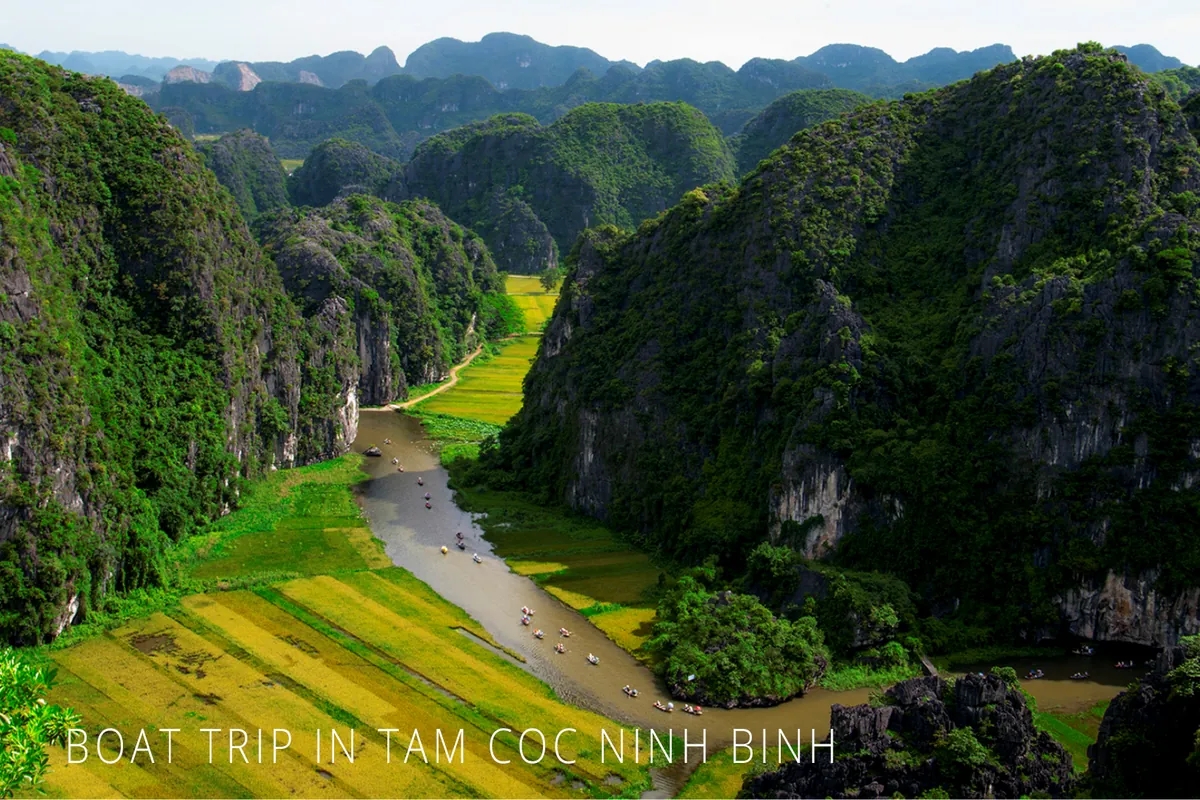
Tam Coc Ninh Binh is a 90–120 minute sampan boat ride along the Ngo Dong River near Ninh Binh city, passing through three limestone caves and seasonal rice-paddy scenery. A boat ticket costs 150,000 VND ($6) for up to 2 passengers as of Q2/2026, and the boat station operates 7:00 AM–4:00 PM daily, 7 km south of Ninh Binh city centre.
Tam Coc Ninh Binh — literally “Three Caves” — is the boat ride that appears on every Vietnam travel poster, and for once the photographs do not lie. The 90-to-120-minute journey along the Ngo Dong River costs 150,000 VND ($6) per boat as of Q2/2026, passes through three limestone caves carved by the river over approximately 2 million years, and winds through rice paddies framed by karst towers that have been forming since the Permian period. I have taken this boat ride in every month of the year, in rain and in heat, at sunrise and at the golden hour before dusk — and the Tam Coc sunset remains, in my estimation, the single most photogenic moment in Ninh Binh province.
I compare Tam Coc with alternatives in my overview of all Ninh Binh boat tour options.
At a Glance
| Detail | Information |
|---|---|
| Location | Tam Coc Boat Station, Van Lam village, Hoa Lu district |
| Ticket Price | 150,000 VND ($6) per boat (max 2 passengers), Q2/2026 |
| Duration | 90–120 minutes (round trip) |
| River | Ngo Dong River |
| Caves | 3: Hang Ca (127m), Hang Hai (60m), Hang Ba (50m) |
| Rowing Method | Foot-rowed sampan (unique to Ninh Binh) |
| Operating Hours | 7:00 AM – 4:00 PM (last departure) |
| Tipping | Expected: 50,000–100,000 VND per boat |
| Distance from Ninh Binh city | 7 km south |
| Nearby | Bich Dong Pagoda (2 km), Mua Cave (3 km) |
The Tam Coc Boat Ride — What to Expect
The Tam Coc boat ride departs from the Tam Coc boat station in Van Lam village, where a concrete pier extends into the Ngo Dong River. You board a metal sampan — flat-bottomed, low-slung, wide enough for two passengers sitting side by side on a wooden plank. Your rower, almost invariably a woman from the surrounding village, takes her position at the stern and begins propelling the boat using a technique found almost nowhere else in the world: foot-rowing. She crosses her legs over the oars and pushes with her feet, leaving her hands free to steer with a secondary paddle.
The community-based tourism programme at Tam Coc employs approximately 2,400 local boatwomen, whose livelihoods depend directly on the river’s ecological health. The shift from diesel to electric boats on this river, completed in 2024, reduced underwater noise by approximately 75% — the fish returned within months.
The journey follows the Ngo Dong River south through rice paddies, passing under karst overhangs and through three caves before turning around at a temple stop and returning by the same route.
The Three Caves of Tam Coc
The name Tam Coc translates as “Three Caves” — Hang Ca, Hang Hai, and Hang Ba — each carved by the Ngo Dong River over approximately 2 million years.
| Cave | Length | Meaning | Notable Features |
|---|---|---|---|
| Hang Ca (First Cave) | 127 m | “Biggest Cave” | Longest passage, stalactites visible in torchlight, boat ducks under low ceiling |
| Hang Hai (Second Cave) | 60 m | “Second Cave” | Shorter, wider opening, bats roosting in ceiling crevices |
| Hang Ba (Third Cave) | 50 m | “Third Cave” | Narrowest entrance, boat barely fits, most intimate of the three |
Inside each cave, the rower navigates by muscle memory and the glow of daylight from the exit. The ceiling drops to roughly one metre above waterline in Hang Ba — you will need to duck. The sound inside is water dripping from stalactites onto the river surface, amplified by the limestone chamber into something between rainfall and applause.
The geological distinction between Tam Coc and Trang An is instructive. Tam Coc’s caves are river-cut — formed by the Ngo Dong River eroding limestone at water level over millennia. Trang An’s caves are phreatic — carved by water flowing under pressure through submerged passages. The practical difference: Tam Coc’s caves are wider and shallower, Trang An’s are deeper and more numerous. For my full geological comparison, see the Tam Coc vs Trang An guide.
Tam Coc Boat Ride Price — Full Cost Breakdown (2026)
| Expense | Cost (Q2/2026) | Notes |
|---|---|---|
| Boat ticket | 150,000 VND ($6) | Per boat, max 2 passengers |
| Tip for rower | 50,000–100,000 VND ($2–$4) | Expected, not mandatory |
| Parking (motorbike) | 10,000 VND | At boat station |
| Parking (car) | 30,000 VND | At boat station |
| Photography service | 50,000–100,000 VND | Offered mid-ride, optional |
| Snacks/drinks at pier | 20,000–50,000 VND | Available at departure area |
| Typical total (2 people) | 230,000–350,000 VND ($9–$14) | Including tips |
A note on tipping: the rowers earn a modest base wage supplemented by tips. The standard is 50,000–100,000 VND per boat ($2–$4). Some rowers offer embroidered goods or snacks for sale during the ride — purchasing is optional, and politely declining is perfectly acceptable.
Best Time to Visit Tam Coc
Time of Day
| Time Slot | Conditions | Recommendation |
|---|---|---|
| 7:00–8:00 AM | Quiet, cool, morning mist on water | Best for photography, fewest boats |
| 8:00–10:00 AM | Tour groups arriving, warming up | Good, moderate crowds |
| 10:00 AM–2:00 PM | Peak crowds, hot, bright overhead light | Avoid if possible |
| 3:00–4:00 PM | Golden light, thinning crowds, warm tones | Best for Tam Coc sunset photos |
Arrive at Tam Coc pier before 7:00 AM and you will have the river largely to yourself — by 9:00, the queue stretches to 40 minutes. The afternoon slot from 3:00 PM offers the golden light that has made Tam Coc sunset photographs ubiquitous on social media — the karst towers glow amber against deepening blue sky, and the rice paddies become liquid gold. The last boat departs at 4:00 PM, returning by approximately 5:30 PM.
Rice Field Seasons — When to See Golden or Green
The rice paddies surrounding the Ngo Dong River transform dramatically with the agricultural calendar, and timing your visit to coincide with the right season makes a measurable difference to the experience.
| Season | Months | Appearance | Photography Rating |
|---|---|---|---|
| Planting | Feb–Mar | Flooded paddies, mirror reflections | ★★★★ |
| Green Growth | Apr–May | Vivid emerald green, lush | ★★★★ |
| Golden Harvest | Late May–early Jun | Gold paddies, peak photography | ★★★★★ |
| Post-Harvest | Jul–Aug | Stubble, brownish, less scenic | ★★ |
| Second Crop Green | Aug–Sep | Green returns, moderate | ★★★ |
| Second Harvest | Sep–Oct | Second golden phase, less dramatic | ★★★★ |
| Dry/Fallow | Nov–Jan | Brown, dormant, misty mornings | ★★★ |
The golden rice harvest in Tam Coc typically peaks between late May and early June — this is the image on every brochure. A second, less photogenic harvest occurs in September–October. For detailed monthly conditions, see my Ninh Binh rice fields guide.
Tam Coc Boat Station — Getting There
The Tam Coc boat station (pier) is located in Van Lam village, approximately 7 km south of Ninh Binh city centre and 7 km from the Trang An boat dock.
Visitors seeking a longer boat experience should consider the Trang An heritage route, 7 km north.
| From | Method | Duration | Cost |
|---|---|---|---|
| Ninh Binh city | Grab/taxi | 15 min | 50,000–70,000 VND |
| Ninh Binh train station | Grab/taxi | 15 min | 60,000–80,000 VND |
| Trang An entrance | Motorbike/taxi | 20 min | 40,000–60,000 VND |
| Hanoi | Train + taxi, or limo van | 2.5h total | See transport guide |
Most visitors staying in the Tam Coc area are within cycling distance (2–5 km) of the boat station. Bicycle rental costs 50,000–80,000 VND ($2–$3) per day — the flat terrain makes this the most practical option.
What to Do Near Tam Coc
The Tam Coc area concentrates several of Ninh Binh’s key attractions within easy cycling or walking distance:
- Bich Dong Pagoda (2 km south) — 250-year-old cave temple, free entrance, 15–20 min walk to the upper pagoda. The poet Nguyen Nghiem inscribed it “the second most beautiful grotto in the land” in 1773.
- Mua Cave viewpoint (3 km northeast) — 486 steps to a 360-degree panorama over the Tam Coc valley. Entry: 100,000 VND ($4). Allow 1.5 hours.
- Thai Vi Temple (1 km south along the river) — Small but historically significant Tran Dynasty (1225–1400) temple, accessible by foot along the rice paddy path.
- Cycling loop — The 15-km circuit from Tam Coc to Bich Dong, through rice fields and past karst towers, is one of the finest cycling routes in northern Vietnam. See my cycling guide.
Food Near Tam Coc Pier
At the roadside stalls near Tam Coc pier, the smell of charcoal-grilled goat reaches you a full fifty metres before the stall itself comes into view. Thit de (goat meat) is Ninh Binh’s signature dish, served in seven preparations: grilled, steamed, stir-fried, raw with lime, in hot pot, smoked, and stewed. Com chay (burnt rice) shatters audibly when you bite through it. A seafood dinner for two at a riverside restaurant averages 300,000–500,000 VND ($12–$20). For the full guide, see Ninh Binh food.
For dining recommendations after your boat ride, see where to eat near Tam Coc.
The Ngo Dong River ecosystem supports foot-rowed boat tourism for 2,400 local families. Carry your rubbish out — there are no bins along the river. The shift to electric boats in 2024 reduced noise pollution by 75%, but plastic waste remains the primary conservation concern. Small courtesies, multiplied by millions of visitors, become consequential.
Tam Coc vs Trang An — Which Boat Tour?
Both Tam Coc and Trang An offer sampan boat tours through karst landscapes, but the experience differs substantially:
| Factor | Tam Coc | Trang An |
|---|---|---|
| Price | 150,000 VND ($6) per boat | 250,000 VND ($10) per person |
| Duration | 90–120 min | 2–2.5 hours |
| Caves | 3 caves | 9 caves (Heritage Route) |
| Scenery focus | Rice paddies + karst | Caves + enclosed valleys |
| UNESCO | Within buffer zone | Core zone — inscribed 2014 |
| Best for | Photography, rice field seasons | Heritage, cave exploration |
| Crowd level | Higher at pier | More dispersed |
My recommendation: if you have time for only one, choose Trang An for the fuller experience. If you have 2+ days, do both — they complement rather than duplicate each other. For the complete analysis, read my Tam Coc vs Trang An comparison.
I generally recommend booking Tam Coc tours through GetYourGuide for verified reviews and flexible cancellation, or check the Klook listing for combo packages that include Tam Coc, Mua Cave, and Bich Dong in a single day.
For the definitive aerial perspective of the Tam Coc valley, climb to the Mua Cave viewpoint, 3 km east.
After your boat ride, walk north to the cave pagoda at Bich Dong, a 2 km walk — a serene three-level temple carved into limestone.
Frequently Asked Questions
How much does the Tam Coc boat ride cost in 2026?
The Tam Coc boat ride costs 150,000 VND ($6) per boat as of Q2/2026. Each boat carries a maximum of 2 passengers. Tipping the rower 50,000–100,000 VND ($2–$4) is expected. Including parking and tips, budget approximately 230,000–350,000 VND ($9–$14) total for two people.
What time does the Tam Coc boat station open?
The Tam Coc boat station operates from 7:00 AM to 4:00 PM daily, with the last boats returning by approximately 5:30 PM. Arrive before 7:00 AM for the quietest experience. Peak hours are 10:00 AM to 2:00 PM — I recommend the early morning slot or the 3:00–4:00 PM golden hour instead.
When is the best time to see golden rice fields at Tam Coc?
The golden rice harvest at Tam Coc typically peaks between late May and early June. A second, less dramatic golden phase occurs in September–October. The vivid green growth stage (April–May) is also highly photogenic. The planting season (February–March) creates mirror-like reflections in flooded paddies.
Is Tam Coc or Trang An better?
Tam Coc is better for rice field photography and budget travellers ($6 vs $10). Trang An is better for cave exploration (9 caves vs 3) and UNESCO heritage. Both are worth visiting. With one day, choose Trang An. With 2+ days, do both. They are 7 km apart.
How long does the Tam Coc boat ride take?
The Tam Coc boat ride takes 90–120 minutes for the round trip along the Ngo Dong River, passing through 3 caves (Hang Ca at 127m, Hang Hai at 60m, and Hang Ba at 50m). The boat turns around at a temple stop before returning by the same route.
Transport details, including bus, train, and private car, are covered in how to reach Tam Coc from Hanoi.
Prices are approximate as of Q2/2026 and subject to change. Verify current rates at Tam Coc boat station before visiting.