In 968 AD, Dinh Bo Linh — a provincial warlord of rather modest origins — united twelve fractious states and declared himself emperor of Dai Co Viet. He chose as his capital not Hanoi, not Hue, but a narrow limestone valley in what we now call Ninh Binh. It was, by any measure, an improbable choice. It was also, I would argue, a brilliant one.
I have spent the better part of twenty-three years trying to understand why.
Academic Background
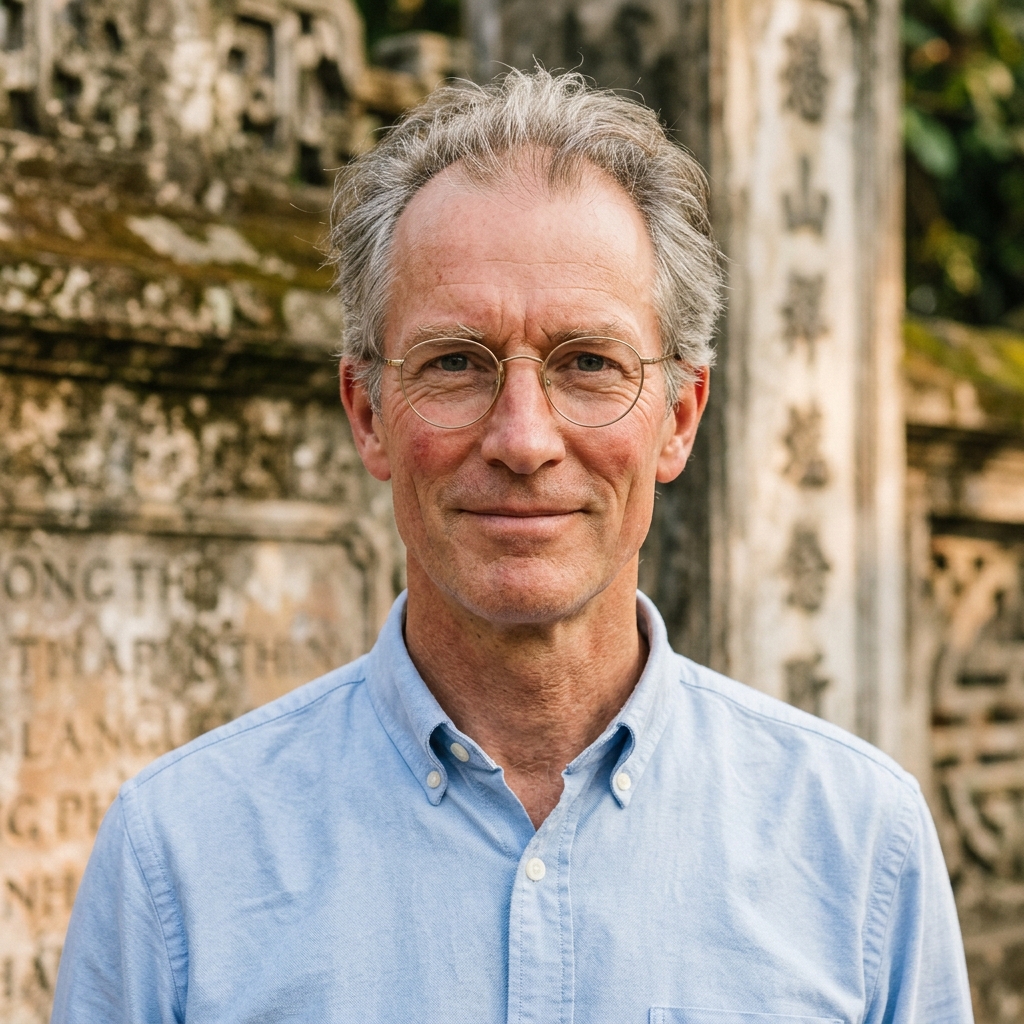
My name is James Whitford. I hold a PhD in Southeast Asian History from the University of Cambridge (1999), where my doctoral thesis examined the administrative structures of the Dinh and Early Le dynasties (968–1009 AD). One notes that this is a rather narrow specialisation — the sort that guarantees stimulating dinner conversation with precisely four people on Earth.

I spent two decades on the faculty at the School of Oriental and African Studies (SOAS), University of London, where I taught courses on pre-modern Vietnamese statecraft, Cham-Vietnamese relations, and the somewhat underappreciated topic of riverine trade networks in medieval Indochina.
Why Ninh Binh
In 2024, I took a sabbatical to conduct fieldwork in Ninh Binh Province — specifically, to document the remaining Dinh and Le dynasty architectural fragments in the Hoa Lu complex before (and one says this with some diplomatic restraint) further “restoration” projects render them unrecognisable.
What I discovered was not merely academic material. I found a province of extraordinary depth — geological, historical, and cultural — that is consistently misrepresented in English-language travel literature. Most guides reduce Ninh Binh to “the Halong Bay on land” (a comparison that is not entirely inaccurate but does rather miss the point). Few mention that the karst formations here predate the dinosaurs by 200 million years, or that Trang An’s caves contain archaeological evidence of human habitation dating to 30,000 years ago.
Best of Ninh Binh is my attempt to provide the sort of travel guidance this province deserves: thorough, historically informed, and (I should hope) not entirely without wit.
Editorial Approach
I believe travel writing should inform, not merely enthuse. You will find on this site:

- Historical context that places each destination within the broader narrative of Vietnamese civilisation
- Practical observations drawn from extended residency, not a three-day press trip
- Honest assessments — including, where warranted, the observation that certain “must-see” attractions are rather less essential than their marketing suggests
- Proper citations when making historical claims (a habit my Cambridge supervisors would be gratified to know I have not abandoned)
📚 A Note on Accuracy: History, like travel, rewards the careful observer. If you find a factual error on this site, I would be genuinely grateful to hear about it. The pursuit of accuracy is, after all, rather the point.
Further Reading
- Nguyen The Anh, Monarchy and Fact in Vietnam (Vithagna, 1971)
- Keith W. Taylor, The Birth of Vietnam (University of California Press, 1983)
- Ninh Binh Province — Wikipedia