
A Complete Guide to Getting Around Ninh Binh
I have spent many years documenting the rural topographies of northern Vietnam, and I must note that navigating this particular province requires a different approach than the major cities. Getting around Ninh Binh is an exercise in choosing the right vehicle for the specific terrain you intend to explore. The region is largely flat, punctuated by sheer limestone karsts, making short-distance travel relatively straightforward but demanding distinct strategies for longer excursions.
Rather than relying on a single mode of transport, I advise adopting a mixed approach. A bicycle is perfect for the immediate environs of your accommodation, while a motorized option is necessary for reaching the distant national parks. I have found the local infrastructure to be highly accommodating to visitors, though it pays to understand the pricing and availability before you arrive. This guide will outline the practicalities of regional transit.
Quick Answer: Getting Around Ninh Binh
- Bicycle: $1 to $3 per day. Best for Tam Coc and local villages.
- Motorbike: $6 to $10 per day. Best for flexibility and reaching distant sites.
- Grab/Taxi: Variable meter rates. Best for point-to-point transfers and rainy days.
- Overall Recommendation: Rent a bicycle for your first day near Tam Coc, then upgrade to a motorbike for exploring wider areas.
Exploring by Bicycle: The Slow Approach
For navigating the immediate surroundings, a bicycle is an exceptionally practical choice. The flat floodplains between the limestone mountains present very little incline, making for an effortless ride. You can rent a standard city bicycle for approximately 30,000 to 50,000 VND (roughly $1.50 to $2.00) per day. Many guesthouses and homestays provide them to their guests on a complimentary basis.
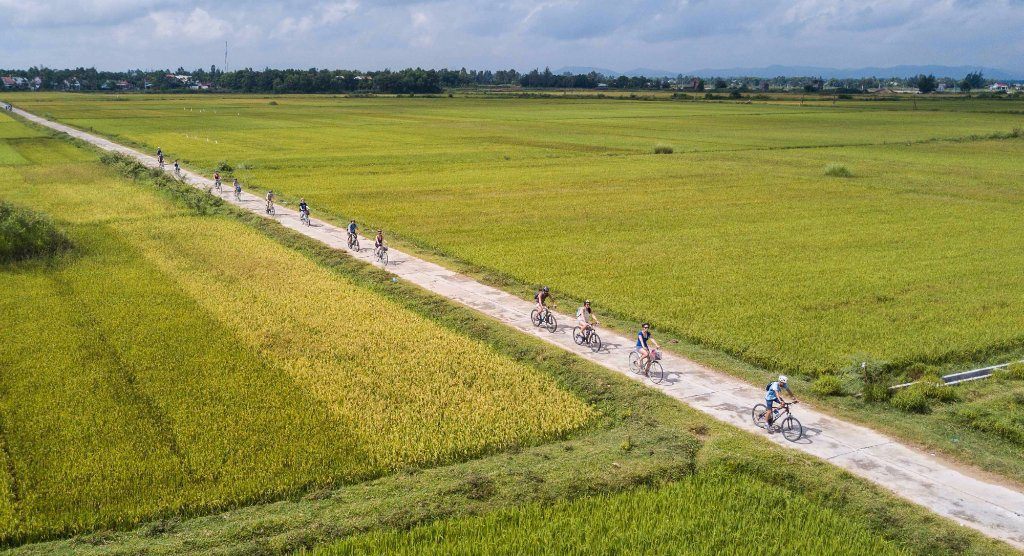
I find this mode of transport particularly suited for the rural pathways winding through the rice paddies. A bicycle allows you to stop easily for photographs without the pressure of moving traffic. It is the ideal vehicle for the short 3-kilometer journey between the main tourist hub and nearby pagodas.
However, bicycles have distinct limitations. The summer heat can be oppressive, and covering distances greater than 10 kilometers becomes physically taxing. I would not recommend cycling from the center all the way to the distant national reserves, as the roads become busier and the journey too long.
| Transport Method | Average Daily Cost (USD) | Best Used For |
|---|---|---|
| Bicycle | $1.50 – $2.00 | Short trips around Tam Coc, leisurely rides |
| Motorbike / Scooter | $6.00 – $10.00 | Trang An, Mua Cave, independent exploration |
| GrabBike | $1.00 – $3.00 per trip | Single journeys for solo travelers |
| Metered Taxi | $3.00 – $8.00 per trip | Families, evening dining, airport transfers |
Motorbike Rentals for Extended Range
To truly access the wider province, renting a motorbike is the most efficient solution. The cost to rent an automatic or semi-automatic scooter is typically between 100,000 and 150,000 VND per day, equating to roughly $4 to $6, though newer models may cost slightly more. Fuel is inexpensive, with a full tank costing under $3, which is sufficient for two days of extensive riding.
I always inspect the vehicle thoroughly before departing. You must check the brakes, the tire tread, and the horn. The local traffic, while less frantic than Hanoi, still operates on a system of spatial negotiation where the horn is used as a locational warning rather than an expression of anger. You should always wear the provided helmet; this is both a legal requirement and a basic safety precaution.
Having a motorbike allows you to reach the Trang An Scenic Landscape Complex early in the morning, ahead of the large tour groups. It also provides the autonomy to visit elevated viewpoints at your own pace, staying for the late afternoon light long after the scheduled tours have departed.
Using Grab and Local Taxi Services
The ride-hailing application Grab operates within the province, though its coverage is not as dense as in the capital. You can reliably secure a GrabCar or GrabBike in the main town and the primary tourist villages. A short 5-kilometer trip will cost approximately 60,000 VND. The primary advantage of this application is the fixed, transparent pricing, which eliminates the need to negotiate with drivers.
Traditional metered taxis are also plentiful. Companies like Mai Linh operate fleets of green vehicles that are reliable and use accurate meters. I have found them useful for evening travel when returning from dinner, or when the weather turns suddenly inclement. You should simply ensure the driver engages the meter upon departure.
During peak holiday periods, wait times for both Grab and traditional taxis can increase significantly. It is prudent to arrange your return transport with your driver when visiting outlying attractions, as finding a vehicle for the return leg can sometimes prove difficult.
Organized Transport and Electric Cars
For those who prefer not to navigate independently, joining a structured tour that includes transport is a sensible alternative. These typically utilize comfortable, air-conditioned vans. Such tours are highly efficient for visiting multiple dispersed sites in a single day. A comprehensive day tour covering the major historical and natural landmarks is bookable as a full-day guided tour on Klook.
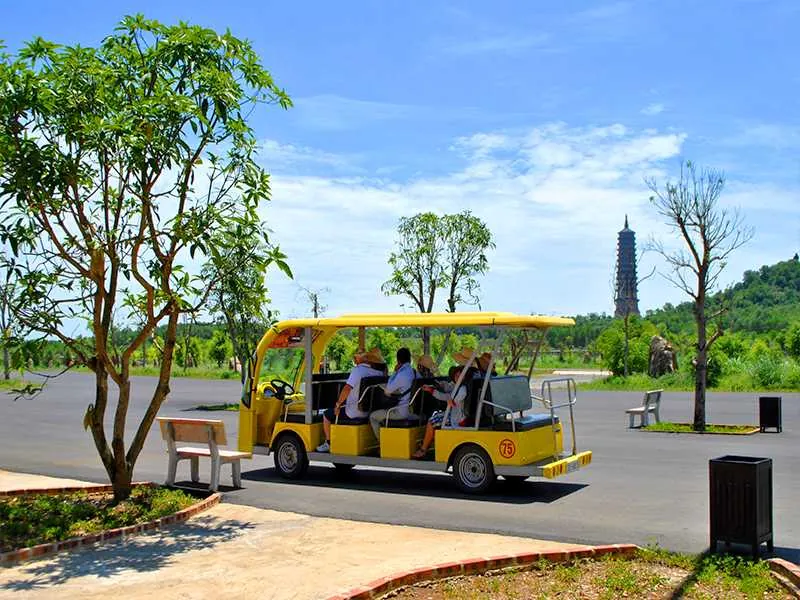
Within certain large complexes, such as Bai Dinh Pagoda, internal transport is managed via electric buggies. The scale of these sites is vast, and walking from the entrance gate to the main structures can take 30 minutes in the open sun. A ticket for the electric car costs 30,000 VND per way. I highly advise utilizing this service to conserve your energy for exploring the actual monuments.
These electric vehicles operate on a continuous loop, picking up and dropping off passengers at designated stations. They are quiet, efficient, and provide a pleasant breeze during the transit. The system is well-organized and prevents the internal roads from becoming congested with private vehicles.
Navigating Specific Regional Routes
Understanding the spatial relationship between the major sites is crucial for efficient planning. The central hub for most visitors is the village near Tam Coc Bich Dong. From here, the journey to the towering viewpoint at Mua Cave is a short 4-kilometer ride, easily achievable by bicycle in twenty minutes.
The route to the ancient structures of Hoa Lu Ancient Capital is longer, approximately 12 kilometers from the southern villages. The road is well-paved and skirts along the edges of several large limestone formations. A motorbike is the optimal choice for this journey, allowing for brief stops to inspect the roadside shrines that dot the landscape.
For the furthest excursions, such as the 45-kilometer journey to the dense primary forests of Cuc Phuong National Park, a motorbike or a hired private car is mandatory. The route transitions from flat plains to rolling hills, and the final stretch into the park is heavily forested. A bicycle is entirely inadequate for this distance.
Safety and Practical Considerations
- Always carry small denominations of Vietnamese Dong (10,000 and 20,000 notes) to pay for parking fees at various attractions, which typically cost 15,000 VND for a motorbike.
- Avoid riding motorbikes after dark on the rural roads, as they are largely unlit and local agricultural vehicles often operate without proper headlights.
- When renting any vehicle, take photographs of its condition before accepting the keys to avoid disputes over pre-existing damage upon return.
- Keep a lightweight rain poncho in your daypack, as sudden, brief showers are common, especially in the late afternoon during the summer months.
Frequently Asked Questions
Do I need an international driver’s permit to rent a motorbike?
Strictly speaking, Vietnamese law requires a valid motorcycle license and an International Driving Permit (IDP) to operate any motorized vehicle over 50cc. While local rental shops rarely ask for documentation, driving without it invalidates most travel insurance policies in the event of an accident.
Is it easy to find parking at the main tourist sites?
Yes, all major attractions have designated, supervised parking areas for both bicycles and motorbikes. The fee is minimal, usually between 10,000 and 15,000 VND. You will be given a small paper ticket or laminated tag; ensure you do not lose it, as you must present it to retrieve your vehicle.
Are there public buses connecting the tourist areas?
There is no practical public bus network connecting the rural tourist sites. The local buses primarily serve residents moving between larger towns. For tourists, relying on bicycles, motorbikes, or taxis is the only viable method for navigating the region.
Can I use credit cards to pay for Grab or taxis?
You can link an international credit card to the Grab application, which handles payments seamlessly. However, for traditional metered taxis and most rental shops, you will need to pay in cash using Vietnamese Dong.
I find that understanding the local transport dynamics significantly reduces the friction of travel. By selecting the appropriate vehicle for each specific excursion, you allow yourself to engage more deeply with the landscape, rather than merely passing through it.
© 2026 bestofninhbinh.com. All rights reserved.
Original research by Dr. James Whitford.
First published on bestofninhbinh.com. Unauthorized reproduction prohibited.