
Hoa Lu Ancient Capital was Vietnam’s first imperial capital, founded in 968 AD by Emperor Dinh Bo Linh and used by the Dinh and Early Le dynasties until 1010 AD. Located 12 kilometres northwest of Ninh Binh city (3 km from Tam Coc), its two surviving 17th-century temples charge 20,000 VND entry and are open 7:00 AM–5:30 PM daily.
Quick Facts: Hoa Lu Ancient Capital
| Location | Truong Yen Commune, Hoa Lu District, Ninh Binh Province |
| Distance from Tam Coc | Approximately 3 km (10-minute drive) |
| Entry Fee | 20,000 VND per person |
| Opening Hours | 7:00 AM – 5:30 PM daily |
| Historical Period | Dinh Dynasty (968-980) and Early Le Dynasty (980-1009) |
| Capital Duration | 41 years (968-1009 AD), before moving to Thang Long (Hanoi) |
| Best Time to Visit | Early morning or late afternoon for fewer crowds |
| Recommended Duration | 1.5 to 2 hours |
From the Desk of Dr. James Whitford:
In 968 AD, a man named Dinh Bo Linh unified twelve warring states and declared himself emperor. His choice of capital was not accidental – the limestone karst mountains surrounding Hoa Lu ancient capital formed a natural fortress, with narrow passes that could be defended by small garrisons against much larger armies. I have walked these passes, studied the surviving temple architecture, and traced the defensive geography. What remains today is modest in scale but immense in historical significance: this is where Vietnam as a unified nation began.
Historical Significance
Hoa Lu served as the capital of Dai Co Viet (the predecessor of modern Vietnam) from 968 to 1010 AD, under two dynasties: the Dinh Dynasty (968-980) and the Early Le Dynasty (980-1009). In 1010, Emperor Ly Thai To relocated the capital to Thang Long (modern Hanoi), citing the need for a more centrally located and commercially viable capital.
The unification itself was hard-won. For over a millennium, from 111 BC to 938 AD, Vietnam existed under Chinese imperial control. Ngo Quyen’s victory at the Battle of Bach Dang River in 938 AD ended that rule, but the following decades collapsed into fragmentation – twelve regional warlords competed for territory in what Vietnamese history calls the “Twelve Warlord Anarchy” (Loạn Thập Nhị Sứ Quân). Dinh Bo Linh, a military commander from this valley, defeated the remaining warlords by 968 and chose Hoa Lu as his capital for a specific reason: the limestone walls ringing the valley formed a citadel that would have required an army several times larger to breach, turning the same karst towers tourists now photograph from Tam Coc boats into 100-metre-high natural ramparts.

The original citadel covered approximately 300 hectares, protected on three sides by limestone mountains and on the fourth by a system of walls, moats, and the Hoang Long River. Of the original structures, only the stone foundations remain. The two surviving temples were rebuilt in the 17th century on the sites of the original palace buildings.
What to See at Hoa Lu
Temple of Dinh Tien Hoang
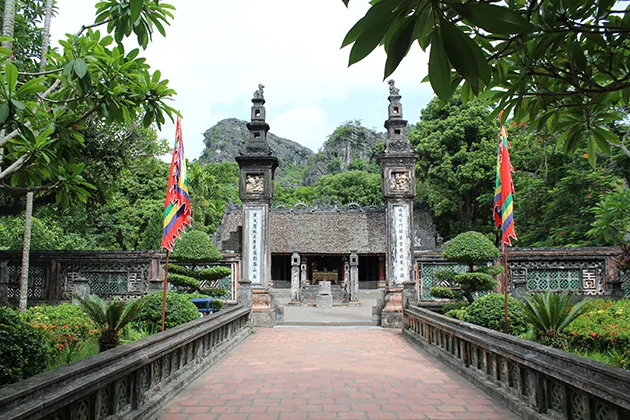
The larger and more ornate of the two temples, dedicated to Emperor Dinh Tien Hoang (Dinh Bo Linh). The temple follows traditional Vietnamese architectural principles: a gate, a courtyard, and three main halls arranged along a central axis. Inside, bronze statues of the emperor and his sons are displayed alongside historical artifacts. The stone pillars and carved dragons date to various restoration periods but maintain the aesthetic conventions of the original.
A few of the dragon carvings on the sanctuary steps are worth slowing down for – they are Dinh-period originals from the late 10th century, not later restorations. Their style differs noticeably from the more sinuous, Chinese-influenced dragon motifs of the later Ly and Tran dynasties, making them physical evidence of a distinctly early Vietnamese artistic tradition and among the oldest surviving stone sculptures in the country.
Temple of Le Dai Hanh
A 10-minute walk from the Dinh temple, this smaller complex honours Emperor Le Dai Hanh, who established the Early Le Dynasty after the Dinh Dynasty fell. The architecture is simpler but equally atmospheric, set against the backdrop of karst towers that served as the dynasty’s natural defence.
Vu Hoa Show
A theatrical performance staged in an outdoor amphitheatre near the temples, depicting key moments from the Dinh and Le dynasties. The production uses 300 performers, water effects, and the karst landscape as a natural backdrop. See our Vu Hoa Show guide for schedules and booking.
The Natural Citadel – Karst Walls as Military Architecture
Hoa Lu’s geology is inseparable from its history. The valley sits inside a ring of Permian-era limestone karst towers – the same formations that define the Ninh Binh landscape at Trang An and Tam Coc – rising 50 to 100 metres above the valley floor. Dinh Bo Linh built his citadel here precisely because those walls did most of the defensive work for him, needing only five gates and a short run of earth-and-stone wall to complete the perimeter. Archaeological surveys have traced roughly 8 km of the original outer walls, enclosing an inner citadel of around 140 hectares where the palace and administrative buildings once stood.

Visiting Hoa Lu
Entry fee: 20,000 VND per person for the temple complex.
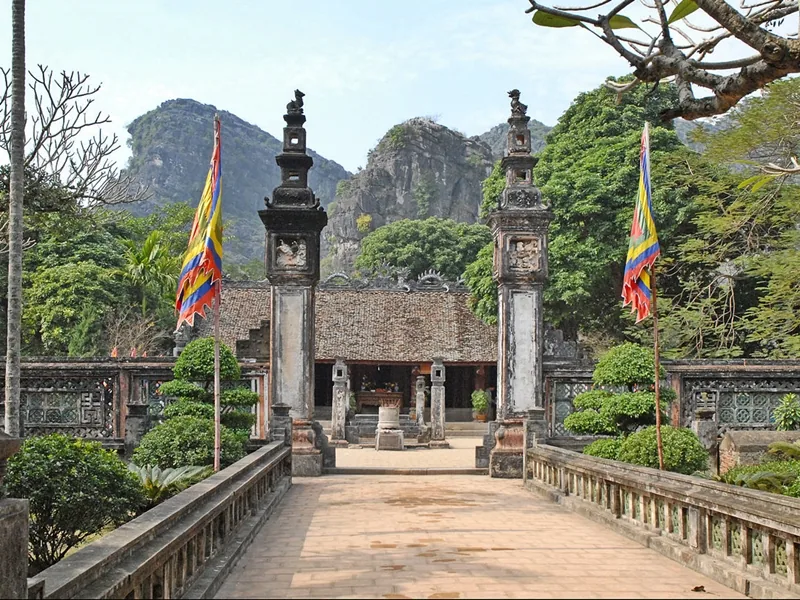
Duration: Allow 1 to 1.5 hours to visit both temples and explore the grounds.
Dress code: Modest clothing is expected (shoulders and knees covered) when entering the temples.
Hoa Lu is located within the Trang An Scenic Landscape Complex and is easily combined with a Trang An boat tour. Most visitors do both in a half-day trip.
Getting There
Hoa Lu is 12 kilometres northwest of Ninh Binh city. The drive takes approximately 20 minutes by taxi or motorbike. Many visitors combine Hoa Lu with Trang An as a single morning itinerary. From Hanoi, organised day trips typically include both destinations. See our transport guide for self-guided options.
| From | Method | Duration | Cost |
|---|---|---|---|
| Tam Coc area | Bicycle | 30–40 min | Free (rental 50–80K VND/day) |
| Tam Coc area | Grab/motorbike | 15 min | 40,000–60,000 VND |
| Ninh Binh city | Grab/taxi | 20 min | 60,000–80,000 VND |
| Trang An entrance | Grab/taxi | 10 min | 30,000–50,000 VND |
Hoa Lu in Vietnamese National Identity
For Vietnamese visitors, Hoa Lu is not simply a historical site – it is foundational. Dinh Bo Linh’s unification of the twelve warlords is taught in every Vietnamese school as the birth of the nation, and the annual Hoa Lu Festival (March/April, lunar calendar) draws thousands of domestic pilgrims to the two temples. For international visitors, I’d suggest approaching Hoa Lu with the same gravity you might bring to the Forum in Rome: the modest scale of the surviving temples belies the enormity of what they represent. Vietnam’s unbroken statehood traces directly back to the decisions made in this valley in 968 AD – which makes the 20,000 VND entry fee, at least by my scholarly reckoning, historically underpriced.
Related Reads
- Hoa Lu Vu Hoa Show Guide
- Trang An UNESCO Complex
- Ninh Binh History and Culture
- Ninh Binh Day Trip from Hanoi
For a comprehensive itinerary that includes Hoa Lu alongside the region’s other treasures, consult our complete Ninh Binh guide. Many travelers pair Hoa Lu with a Tam Coc boat excursion and a visit to the Trang An Scenic Landscape Complex for a full day of exploration.
For additional historical context on the Dinh and Le dynasties, the Wikipedia entry on Hoa Lu provides a detailed chronological overview.
To arrange your visit with reliable transport, I recommend that you find Hoa Lu Ancient Capital tours on 12Go for verified schedules and e-ticket booking.
Frequently Asked Questions
What dynasties ruled from the Hoa Lu ancient capital?
The Dinh Dynasty under Emperor Dinh Tien Hoang established Hoa Lu as Vietnam’s capital in 968 AD, followed by the Early Le Dynasty under Le Dai Hanh from 980 to 1009. The capital was relocated to Thang Long (modern-day Hanoi) by Emperor Ly Thai To in 1010, ending Hoa Lu’s 41-year reign as the political center of Dai Co Viet.
How far is Hoa Lu from other Ninh Binh attractions?
Hoa Lu sits approximately 3 km north of Tam Coc and 12 km from Trang An Scenic Landscape Complex. Most visitors combine Hoa Lu with a Tam Coc boat tour in a single half-day itinerary, as the drive between them takes only 10 minutes through karst-lined countryside roads.
Is the Hoa Lu ancient capital worth visiting compared to Tam Coc?
Hoa Lu offers a fundamentally different experience from Tam Coc’s natural scenery. The two remaining temples — dedicated to Emperor Dinh Tien Hoang and Emperor Le Dai Hanh — feature 17th-century architecture with intricate stone and wood carvings that reveal Vietnamese artistic traditions spanning multiple centuries. Budget approximately 1.5 hours for a thorough visit.
What is the entrance fee for Hoa Lu Ancient Capital?
Entry to the Hoa Lu temple complex costs 20,000 VND per person. The site is open 7:00 AM to 5:30 PM daily.
How long should I plan for a visit to Hoa Lu?
Most visitors need about 1.5 to 2 hours to see both temples (Dinh Tien Hoang and Le Dai Hanh) and explore the grounds.
Why did Vietnam move its capital from Hoa Lu to Hanoi?
In 1010, Emperor Ly Thai To relocated the capital to Thang Long (modern Hanoi) because the Red River Delta offered better agricultural output, river-trade access, and room for urban expansion. Hoa Lu’s limestone fortress was excellent for defence but limiting for a growing imperial administration – the move marked Vietnam’s shift from a frontier military state to a settled agrarian empire.