Bai Dinh Pagoda is Southeast Asia’s largest Buddhist complex, located 15km northwest of Tam Coc in Ninh Binh province. The 700-hectare new complex (built 2003–2014) houses a 10-metre, 100-tonne bronze Buddha, a 36-tonne bronze bell, and 500 stone Arhat statues. Entry is free (voluntary donation); the electric cart costs 30,000 VND one-way.
From the Desk of Dr. James Whitford:
Bái Đính is not what most visitors expect from a Vietnamese pagoda. It is not intimate, not ancient, and not subtle. It is the largest Buddhist complex in Southeast Asia — 700 hectares of monumental architecture, a 100-tonne bronze Buddha, and 500 stone Arhat statues lining corridors that stretch further than the eye can comfortably follow. My colleagues in Cambridge’s architecture department would call it “assertive.” I call it fascinating, precisely because it challenges every assumption about Vietnamese religious restraint. This is particularly relevant when considering bai dinh pagoda options for your visit.
Related Guides
- The Ultimate Ninh Binh Travel Guide 2026
- Ninh Binh Solo Travel 2026: Safety, Tips & Meeting Other Travelers
For more information, see Ninh Bình province. Understanding bai dinh pagoda in this context helps with trip planning.
Bái Đính Pagoda — located 15km northwest of Tam Cốc in Ninh Bình province — holds multiple records as Southeast Asia’s largest Buddhist complex: the tallest bronze Buddha statue (10m, 100 tonnes), the heaviest bronze bell (36 tonnes), and the longest Arhat corridor (500 stone statues). This guide covers both the historic original pagoda and the modern new complex. For visitors researching bai dinh pagoda, this information proves especially useful.
At a glance:
- Total area: 700 hectares (new complex) + 27 hectares (historic pagoda)
- Entry fee: Free (voluntary donation); electric cart 30,000 VND one-way
- Key records: Largest bronze Buddha in SE Asia (10m/100t), heaviest bell (36t), 500 Arhat statues
- Location: Gia Sinh commune, Gia Viễn district, 15km from Tam Cốc
- Time needed: 2–3 hours (new complex) + 1 hour (historic pagoda)
- Best time: Early morning (07:00) to avoid afternoon heat and tour bus crowds
What Makes Bai Dinh the Largest Pagoda in Southeast Asia?
Bái Đính Pagoda holds its “largest” designation through sheer scale — the new complex (completed 2014, 700 hectares) houses a 10-metre bronze Shakyamuni Buddha weighing 100 tonnes, a 36-tonne bronze bell, 500 individually carved stone Arhat statues along a 2km corridor, and three main worship halls each exceeding 2,000 square metres.
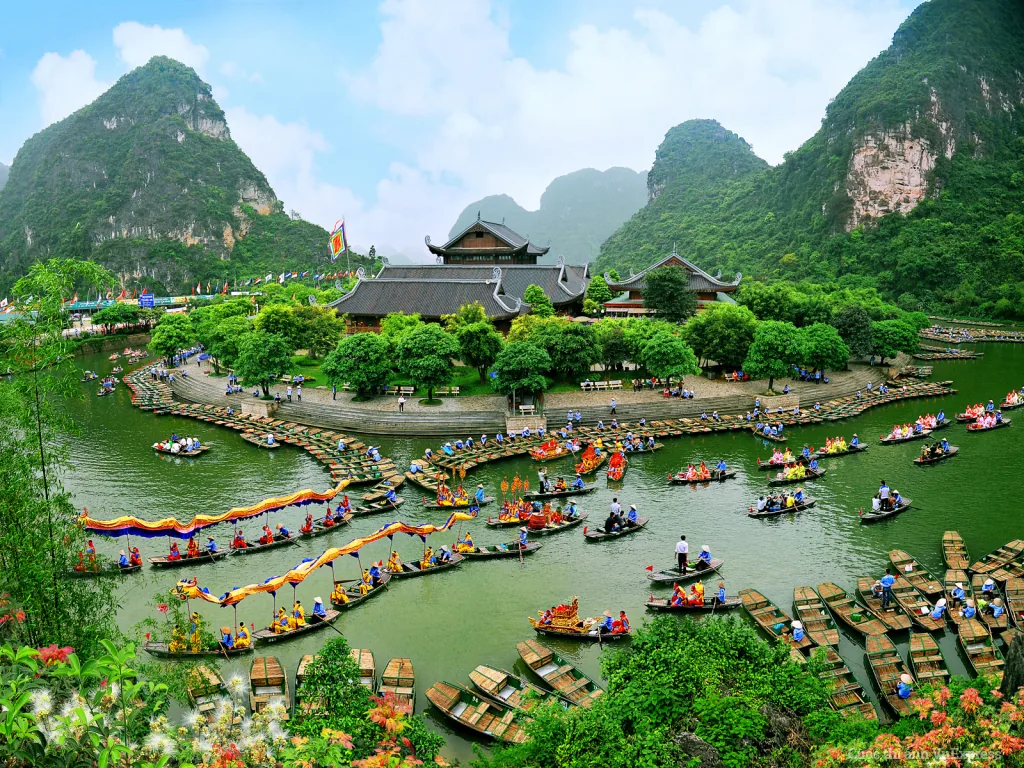
The scale is deliberate. The complex was conceived in 2003 by the Vietnamese government as a national Buddhist centre — a statement of cultural identity as much as a place of worship. The construction employed 5,000 workers over eleven years, using Ninh Bình limestone quarried from the surrounding karst formations. The result is architecturally coherent if aesthetically overwhelming — every element is supersized, from the 152-step entrance stairway to the ceremonial courtyard that accommodates 5,000 worshippers simultaneously.
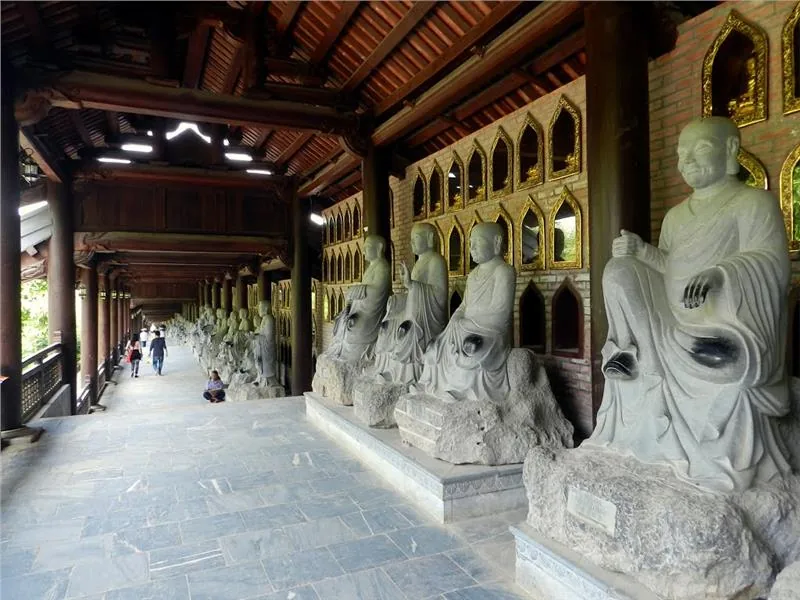
The 500 Arhat statues deserve specific attention. Each is carved from a single block of Ninh Bình blue stone (đá xanh), standing 2m tall, with individual facial expressions, hand positions, and robes that reflect 500 distinct Buddhist saints. Walking the corridor — 2km of stone figures on both sides, their expressions shifting from serene to fierce to amused — creates a cumulative effect that I find genuinely compelling, regardless of one’s relationship to Buddhism.
Bai Dinh Old Pagoda vs New Complex: Which to Visit?
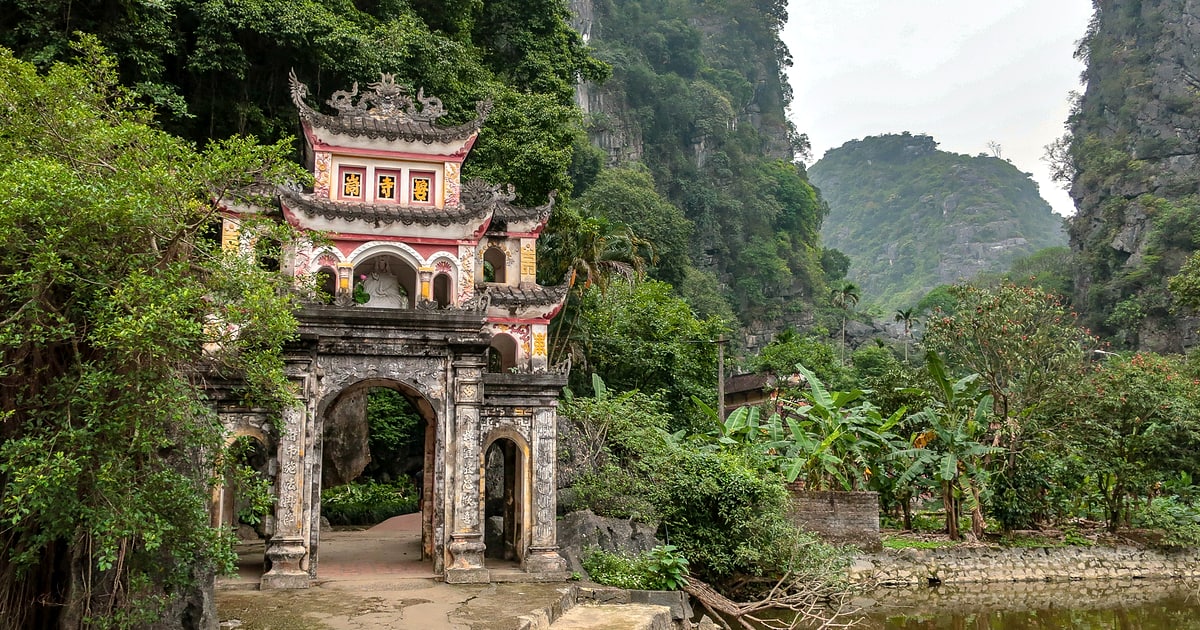
The original Bái Đính Pagoda (11th century, 27 hectares) offers authentic historical atmosphere with cave shrines built into the limestone cliff, while the new complex (2003–2014, 700 hectares) delivers monumental scale — visit both for the complete experience, starting with the old pagoda for its intimacy before the new complex’s grandeur.
The old pagoda is what I would call the “real” Bái Đính — a collection of cave shrines carved into the limestone hillside during the Lý dynasty (11th century), accessed by forest paths that smell of damp stone and frangipani. The Jade Well (Giếng Ngọc), a natural karst spring, still provides water to the resident monks. The Dim Cave (Hang Tối) houses a 13th-century Buddha carved directly into the rock face — a work of devotional art that predates the new complex by 800 years and surpasses it, in my estimation, in spiritual authenticity.
How to Get to Bai Dinh Pagoda from Tam Coc
Bái Đính sits 15km northwest of Tam Cốc — reachable in 25 minutes by motorbike (the recommended option), 40 minutes by bicycle (for fit riders, flat terrain), or 15 minutes by taxi/Grab (approximately 80,000 VND one-way).
Active visitors can rent a bicycle and ride the 12 km temple corridor connecting Bai Dinh to Hoa Lu.
The route from Tam Cốc to Bái Đính passes through rice paddies and small villages, with karst towers providing a continuous backdrop. It is one of the more scenic commutes in Ninh Bình, and I recommend the motorbike option for the flexibility to stop at roadside points where the landscape composition warrants a photograph — which, on this route, is approximately every 800 metres.
Bai Dinh Practical Tips: What to Know Before Visiting
Three practical details significantly improve the Bái Đính experience: arriving before 08:00 (to explore the Arhat corridor without tour groups), taking the electric cart one-way uphill (30,000 VND, saves 30 minutes of sun exposure) and walking downhill through the corridors, and wearing comfortable shoes for the 3–4km of walking surfaces.
- Dress code: Shoulders and knees covered (as with all Vietnamese pagodas)
- Photography: Permitted in all areas; no flash inside worship halls
- Electric cart: 30,000 VND one-way from entrance to main hall (recommended uphill)
- Water: Bring 1L minimum; limited vendors inside the complex
- Duration: 2–3 hours new complex; add 1 hour for old pagoda
- Combine with: Tràng An (7km south) for a full-day programme
Frequently Asked Questions
Is Bai Dinh Pagoda free to enter?
Yes. Entry to both the old and new pagoda complexes is free. The electric cart within the new complex costs 30,000 VND one-way. Parking: 10,000 VND (motorbike), 30,000 VND (car).
How long do you need at Bai Dinh?
2–3 hours for the new complex including the Arhat corridor, main halls, and bell tower. Add 1 hour for the historic old pagoda. Total: 3–4 hours for the complete experience.
Is Bai Dinh worth visiting?
Yes, particularly if you appreciate monumental architecture or Buddhist art. The 500 Arhat statues and the cave shrines of the old pagoda are genuinely compelling. Skip it only if you have fewer than 2 days in Ninh Bình and must prioritise Tam Cốc, Tràng An, and Múa Cave.
Should I visit Bai Dinh’s old pagoda or the new complex?
Visit both if you have time. The original 11th-century pagoda (27 hectares) offers cave shrines built into the limestone cliff and a more intimate, historical atmosphere, while the new complex (2003–2014, 700 hectares) delivers monumental scale — start with the old pagoda before the new complex’s grandeur.
How do I get to Bai Dinh Pagoda from Tam Coc?
Bai Dinh is 15km northwest of Tam Coc — about 25 minutes by motorbike, 40 minutes by bicycle, or 15 minutes by taxi/Grab (approximately 80,000 VND one-way).
🏛️ Explore Ninh Binh with Expert Guides — Book a private Ninh Binh tour with knowledgeable local guides who bring the UNESCO heritage to life. All-inclusive day trips from Hanoi starting at $45/person.
📚 Dr. Whitford’s Note: Bai Dinh presents an interesting challenge to the academic observer: a modern construction of extraordinary scale that has, within barely a decade, acquired the atmospheric gravity of a much older place.
Further Reading
— Dr. James Whitford, Heritage Studies | University of Melbourne
This article contains affiliate links. When you book through our partner links, we may earn a small commission at no additional cost to you. This supports our continued research across Ninh Bình province.
— J. Whitford, PhD.
Cambridge, UK / Ninh Bình, VN
Disclosure: Some links in this guide may be affiliate links. I only recommend services I have personally verified.
📌 Book this experience:
Some links are affiliate links. We earn a small commission at no extra cost to you.
📍 Explore more: all Ninh Binh destinations →
To arrange your visit with reliable transport, I recommend that you arrange transport to Bai Dinh Pagoda on 12Go for verified schedules and e-ticket booking.